
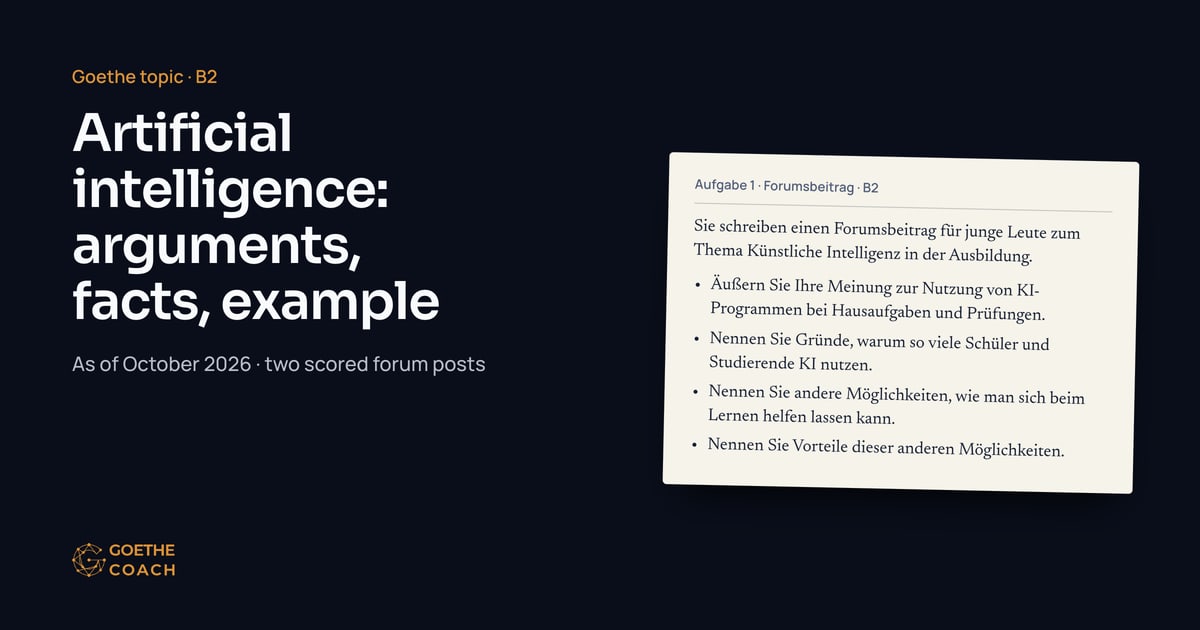
What does the AI topic look like in the exam?
Usually it comes down to one simple question: is AI at school, at work or in everyday life more of a chance or a risk? The task sets the situation, for example a forum post for young people, and gives four Leitpunkte.
There is no official topic list. In the B2 Forumsbeitrag you write about a current social topic, at least 150 words. Which other topics are typical is covered in our overview Goethe exam topics.
In the 67 exam reports from 2026 we collected, AI came up only once (a C1 talk on introducing AI in the workplace); phones, social media and online shopping came up much more often (Goethe exam topics). The arguments overlap a lot: dependence, time, data protection, jobs.
In other words: you don't need to know how a language model works. You need an opinion, reasons for it, and one alternative.
Which facts can I mention?
Three facts are enough, and each has a date. A concrete date makes an argument more convincing than "nowadays" ("heutzutage").
| Fact | Since | Use in your text |
|---|---|---|
| ChatGPT became publicly available | November 2022 | Introduction: „Seit Ende 2022 …“ |
| Germany's conference of education ministers (KMK) recommends a "critical and constructive" approach to AI in schools; exam culture is to change too | 10 October 2024 | Your opinion on AI for homework and exams |
| The EU AI Act has been in force since August 2024; certain AI practices have been banned since February 2025; since 2 August 2026 it largely applies. Obligations for high-risk AI were postponed to late 2027 / 2028 | 2024–2028 | The "rules instead of a ban" argument |
As of October 2026. Dates like these change: we review this page every quarter.
What are the arguments for and against?
The strongest arguments are concrete: time, learning and medicine on one side; jobs, data and dependence on the other. Every argument needs an example, otherwise it is just a claim.
| For (dafür) | Example | Against (dagegen) | Example |
|---|---|---|---|
| KI spart Zeit bei Routinearbeit | summarising e-mails, planning appointments | Man lernt weniger selbst | if a program writes every text, you only practise copying |
| Individuelles Lernen | a program explains a rule a third time, without impatience | KI macht Fehler und erfindet Quellen | an answer sounds certain and is still wrong |
| Hilfe in der Medizin | images are analysed faster | Datenschutz | private data ends up with big companies |
| Neue Berufe entstehen | data and AI specialists are in demand | Arbeitsplätze fallen weg | simple office tasks get automated |
A good post doesn't use all eight. Two arguments with examples are worth more than five without.
How do the arguments fit the Leitpunkte?
B2 Leitpunkte almost always follow the same patterns: give your opinion, give reasons, name other options, name their advantages. That is exactly how the official Goethe B2 model test does it, just with a different topic.
For a task on AI in education that means:
- Meinung äußern: „Meiner Meinung nach darf KI beim Lernen helfen, aber nicht das Lernen ersetzen.“
- Gründe nennen: free, always available, time pressure next to school and a part-time job.
- Andere Möglichkeiten nennen: study group, tutoring, the teacher's office hours.
- Vorteile nennen: you can ask back, you understand your mistakes, you learn to work in a team.
This is where points get lost. In GoetheCoach practice texts (2026), a Leitpunkt is missing almost twice as often in the B2/C1 Forumsbeitrag as in the formal message, usually points 3 and 4. More: Why Leitpunkte cost so many points.
Which words do I need?
These 15 words and phrases carry almost any AI text. Always learn nouns with their article.
| Word / phrase | Example |
|---|---|
| die Künstliche Intelligenz (KI) | KI verändert, wie wir lernen. |
| das Sprachmodell, -e | Ein Sprachmodell schreibt Texte auf Knopfdruck. |
| die Hausaufgabe, -n | Viele lassen ihre Hausaufgaben von KI schreiben. |
| der Datenschutz | Der Datenschutz ist ein großes Problem. |
| die Abhängigkeit | Es besteht die Gefahr einer Abhängigkeit. |
| die Automatisierung | Die Automatisierung ersetzt einfache Tätigkeiten. |
| der Arbeitsplatz, -¨e | Manche Arbeitsplätze könnten wegfallen. |
| die Fehlinformation, -en | KI kann Fehlinformationen verbreiten. |
| die Lerngruppe, -n | In einer Lerngruppe kann man nachfragen. |
| eine Rolle spielen | KI spielt im Studium eine immer größere Rolle. |
| Bedenken äußern | Viele Lehrkräfte äußern Bedenken. |
| Verantwortung übernehmen | Wer KI nutzt, muss Verantwortung übernehmen. |
| zur Verfügung stehen | Die Programme stehen rund um die Uhr zur Verfügung. |
| in Frage stellen | KI stellt klassische Hausaufgaben in Frage. |
| Regeln aufstellen | Schulen sollten klare Regeln aufstellen. |
For linking your sentences: Redemittel and connectors for B2 and C1.
What does a typical B2 text look like, and a good one?
We answered the same task twice and scored both texts with GoetheCoach: two readings, averaged like the two Goethe raters. This is our rating, not an official one. The task:
Sie schreiben einen Forumsbeitrag für junge Leute zum Thema Künstliche Intelligenz in der Ausbildung. Äußern Sie Ihre Meinung zur Nutzung von KI-Programmen bei Hausaufgaben und Prüfungen. Nennen Sie Gründe, warum so viele Schüler und Studierende KI nutzen. Nennen Sie andere Möglichkeiten, wie man sich beim Lernen helfen lassen kann. Nennen Sie Vorteile dieser anderen Möglichkeiten. Schreiben Sie mindestens 150 Wörter.
Text A: typical (156 words)
Hallo zusammen,
ich möchte meine Meinung zum Thema KI in der Schule und im Studium schreiben. Heute benutzen sehr viele Schüler ChatGPT oder andere Programme für die Hausaufgaben. Ich finde das nicht so gut, weil man dann selbst nichts lernt. Bei Prüfungen ist es noch schlimmer, denn das ist Betrug und unfair für die anderen.
Warum benutzen so viele junge Leute KI? Der wichtigste Grund ist, dass es sehr schnell geht. Man schreibt eine Frage und nach paar Sekunden hat man eine perfekte Antwort. Außerdem haben viele Schüler zu viel Stress, weil sie neben der Schule auch arbeiten oder Sport machen. Ein anderer Grund ist, dass die Lehrer oft keine Zeit haben, alles zu erklären, und die KI ist immer da.
Man kann natürlich auch andere Hilfe finden, zum Beispiel Freunde fragen.
Zusammenfassend denke ich, dass KI ein nützliches Werkzeug sein kann, aber man darf es nicht für alles benutzen. Die Schulen müssen klare Regeln machen.
Text B: good (182 words)
Liebe Forumsmitglieder,
kaum ein Thema wird an Schulen und Hochschulen gerade so heftig diskutiert wie Künstliche Intelligenz. Deshalb möchte ich hier meine Sicht darstellen.
Meiner Meinung nach darf KI beim Lernen helfen, aber nicht das Lernen ersetzen. Wer sich eine Hausaufgabe komplett von einem Programm schreiben lässt, trainiert nur das Kopieren. In Prüfungen hat KI ohne ausdrückliche Erlaubnis nichts zu suchen, denn dort soll gezeigt werden, was man selbst kann.
Dass trotzdem so viele Schüler und Studierende KI nutzen, hat mehrere Gründe. Zum einen sind die Programme kostenlos und rund um die Uhr verfügbar. Zum anderen fühlen sich viele unter Zeitdruck, weil Schule, Nebenjob und Freizeit kaum zu vereinbaren sind.
Es gibt jedoch auch andere Möglichkeiten, sich beim Lernen helfen zu lassen: Lerngruppen mit Mitschülern, Nachhilfe oder die Sprechstunde der Lehrkräfte. Der Vorteil dieser Wege liegt darin, dass man nachfragen kann und Fehler wirklich versteht. Außerdem motiviert es, gemeinsam an einer Aufgabe zu arbeiten, und man lernt nebenbei, im Team zu kommunizieren.
Alles in allem halte ich KI für ein nützliches Werkzeug, solange wir sie bewusst und ehrlich einsetzen.
Viele Grüße
Lena
The scores
| Criterion (max.) | Text A | Text B | Why |
|---|---|---|---|
| Erfüllung (14) | 7 | 14 | A: Leitpunkt 3 is half a sentence, Leitpunkt 4 is missing. B: all four complete. |
| Kohärenz (14) | 10.5 | 14 | A: clear structure, but paragraph 3 is a single sentence. B: connectors like „zum einen … zum anderen“, „jedoch“. |
| Wortschatz (16) | 8 / 12 | 16 | A: „nach paar Sekunden“, „Regeln machen“; the two readings disagreed here. |
| Strukturen (16) | 8 / 12 | 16 | A: simple sentences, small errors; B: confident subordinate clauses and infinitives. |
| Total (60) | 38 (63%) | 60 (100%) | A: two readings, 33.5 and 41.5. B: full marks in both readings. |
In other words: Text A loses 7 points on Erfüllung alone, not on language. Two sentences about study groups and their advantages would have been enough. Text B's 60 out of 60 doesn't mean real examiners would certainly give full marks. It means all Leitpunkte are there and the language carries them. How we score and where our limits are: How GoetheCoach scores writing.
Does this help for the Sprechen exam too?
Yes: in Sprechen Teil 2 (B2) you discuss a current question for about five minutes, exchange arguments and say at the end whether you are for or against. A question like „Sollte KI in der Schule erlaubt sein?“ needs the same arguments as the forum post.
GoetheCoach only trains writing. But once you have put your arguments in order on paper, they come to you faster in the discussion.
A word on AI model texts
Many model texts online are now written by AI themselves and were never checked. An AI model text on exactly this topic that we saw in a search engine in October 2026 had the English word "strictly" in the middle of a German sentence. Use model texts for ideas, not as templates to memorise. Why AI feedback is often too generous: ChatGPT said I would pass.
Frequently asked questions
Do I need to know laws like the EU AI Act?
Can I abbreviate it to "KI"?
What if the topic is "robots" or "digitalisation"?
How many words does the forum post need?
Can I use "du" or "ihr" in the forum?
Do I have to be against AI to score well?
Can you cover all four Leitpunkte?
This is what a real B2 task on a current topic looks like. Write tasks like this one and see your points per criterion – with a tutor who works on your gaps with you. Free.
Aufgabe 1 · Forumsbeitrag · B2
Sie schreiben einen Forumsbeitrag für junge Leute zum Thema Künstliche Intelligenz in der Ausbildung.
- Äußern Sie Ihre Meinung zur Nutzung von KI-Programmen bei Hausaufgaben und Prüfungen.
- Nennen Sie Gründe, warum so viele Schüler und Studierende KI nutzen.
- Nennen Sie andere Möglichkeiten, wie man sich beim Lernen helfen lassen kann.
- Nennen Sie Vorteile dieser anderen Möglichkeiten.
Denken Sie an eine Einleitung und einen Schluss. Schreiben Sie mindestens 150 Wörter.