
Is there an official topic list?
No. The task only names the topic in the exam, and current social questions are typical. In the official Goethe B2 model test it is a forum post „für junge Leute zur Verschmutzung der Umwelt“ (for young people, about pollution), specifically about plastic packaging in everyday life.
Lists of "all topics" collect what others met in earlier exams. They help you practise, but they are not a prediction. If you only memorise lists, a new topic leaves you without a plan.
In other words: don't prepare 100 topics. Prepare one method that works for any topic, and a few topic areas in depth.
Where do topics show up in the exam?
The same topic area can come up in Schreiben and in Sprechen. The tasks differ, the arguments don't.
| Level | Schreiben | Sprechen |
|---|---|---|
| B1 | Teil 2: opinion in a forum, around 80 words | Teil 2: present a current topic, you pick 1 of 2 topics (around 3 minutes) |
| B2 | Teil 1: Forumsbeitrag, at least 150 words, four Leitpunkte | Teil 1: talk, you pick 1 of 2 topics (around 4 minutes). Teil 2: discussion of a current question (around 5 minutes) |
| C1 | Teil 1: contribution to a forum discussion, around 230 words | Talk on a complex topic and discussion of a controversial topic |
In the B2 model test the talk topics are, for example, „Finanzierung des Studiums“ (financing your studies), „Gesund leben“ (healthy living) or „Ernährung am Arbeitsplatz“ (eating at work). The discussion question is: „Sollen Studierende ihre Professoren beurteilen?“ (Should students rate their professors?)
Which topics do candidates report in 2026?
We collected what candidates publicly write about their Goethe exam in 2026: every Reddit post and comment mentioning "Goethe" from January to October 2026, about 1,100 discussions. That left 67 reports of topics in the Forumsbeitrag, the presentation, the talk and the discussion, from 34 discussions (B1 to C2, mostly B2).
| Topic area | Reports | Examples |
|---|---|---|
| Transport and leisure | 15 | public transport (B2 talk, four times), eco-friendly travel (B2 forum, three times), speed limit on motorways (C1 discussion), car sharing (C1 forum) |
| Health and society | 13 | „Gesund leben ohne Chemie“ and dealing with stress (B2 talk), labelling unhealthy food (C1, twice), smoking ban (C1), volunteering (C2) |
| Media and technology | 10 | phones and smartphones in everyday life (B2 forum, three times), social media ban under 16 (C1 talk), e-books and reading on screen (B1 forum), online shopping (B1) |
| Education | 10 | choosing what to study (B2 talk, twice), studying or earning money, foreign languages (B1), private and state schools (C1) |
| Environment and consumption | 9 | food waste (B2 forum, twice), shop opening hours (B1/B2, three times), meat-free diet (C1), cutting greenhouse gases in everyday life (C1 forum) |
| Work | 8 | four-day week or shorter hours (B2 discussion, twice), working from home (B2), flexible hours (C1), work and family (C1 forum), AI in the workplace (C1 talk) |
| Housing and city | 2 | car-free city centre (B1 forum), housing during vocational training (B2) |
In other words: the topics are everyday and social. Some come back, such as public transport or choosing what to study. Artificial intelligence came up only once (a C1 talk on "introducing AI in the workplace", exam date not stated), the phone in everyday life three times.
How we collected: every post and comment mentioning "Goethe" in r/German, r/Germanlearning, r/germany, r/de, r/AskGermany and r/IWantOut (1 January to 18 October 2026). An AI pulled out the topics; we checked every quote word for word against the source. We only counted topics someone had in a real Goethe exam, not practice tasks. 38 of the 67 reports state the exam month; the rest count with the month of the post. We name topic areas, not task texts. Not representative: people who post online are not the average candidate. As of October 2026; we add to the collection every month.
All 67 reports with sources: goethe-exam-topics-2026.json.
For the most common areas we are building topic pages with arguments, vocabulary and scored texts. The first is a classic practice topic: artificial intelligence.
How do I prepare a topic in 20 minutes?
With a fixed grid: three arguments for, three against, one example of your own, one alternative, eight topic words. It fits on half a sheet and works for any topic.
- Turn it into a question (2 minutes). Make the topic a yes/no question: „Sollte Homeoffice für alle möglich sein?“
- Three arguments for, three against (8 minutes). Each with a short example.
- One example of your own (3 minutes). Something from your life you can tell in two sentences.
- One alternative (2 minutes). Many B2 tasks ask for "other options" („andere Möglichkeiten“) and their advantages.
- Eight topic words (5 minutes). Nouns with their article and two noun-verb phrases (Nomen-Verb-Verbindungen).
Why the alternative? B2 Leitpunkte almost always follow the same patterns: give your opinion, give reasons, name other options, name their advantages. If you have prepared points 3 and 4, you are less likely to forget them in the exam.
Where do learners lose points on a topic?
Usually not on vocabulary, but on a missing Leitpunkt. That is what scored GoetheCoach practice texts from 2026 show (not representative, but clear patterns).
| What we see | Share |
|---|---|
| Learners who name "no ideas" as their writing weakness | about 4 in 10 |
| B2/C1: Leitpunkt missing in the forum post vs. the formal message | 68% vs. 36% |
| B2: average with all Leitpunkte vs. with one missing | 75% vs. 52% |
In other words: one missing Leitpunkt costs more than 20 percentage points on average. Knowing the topic helps, but working through the Leitpunkte decides. The full analysis: Why Leitpunkte cost so many points.
Does this help for the Sprechen exam too?
Yes. The discussion in Sprechen Teil 2 asks for a position, arguments, a reaction to your partner and, at the end, a clear "for" or "against". Your 20-minute grid gives you exactly that.
GoetheCoach only trains writing. But once you have put your arguments in order on paper, you find them faster in the oral exam.
Frequently asked questions
Do the topics come from the news?
What if I don't know a topic at all?
Do I need current facts and figures?
Are the topics the same at B1 and C1?
How many words does the B2 forum post need?
Is it worth memorising "all topics"?
Can you cover all four Leitpunkte?
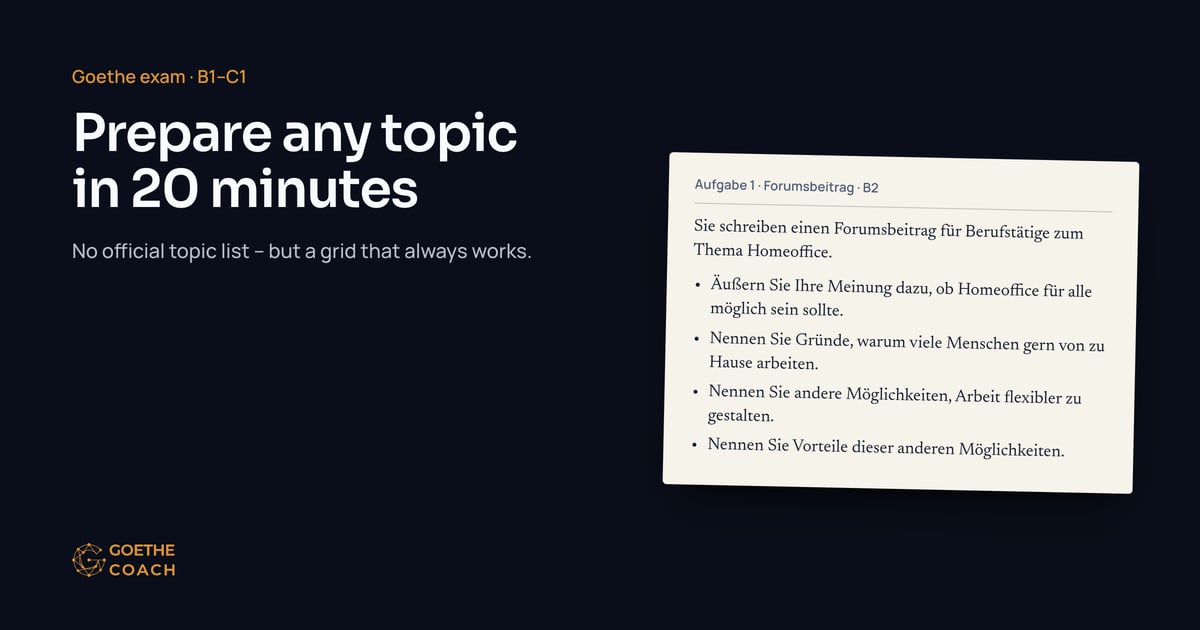
This is what a real B2 task on a current topic looks like. Write tasks like this one and see your points per criterion – with a tutor who works on your gaps with you. Free.
Aufgabe 1 · Forumsbeitrag · B2
Sie schreiben einen Forumsbeitrag für Berufstätige zum Thema Homeoffice.
- Äußern Sie Ihre Meinung dazu, ob Homeoffice für alle möglich sein sollte.
- Nennen Sie Gründe, warum viele Menschen gern von zu Hause arbeiten.
- Nennen Sie andere Möglichkeiten, Arbeit flexibler zu gestalten.
- Nennen Sie Vorteile dieser anderen Möglichkeiten.
Denken Sie an eine Einleitung und einen Schluss. Schreiben Sie mindestens 150 Wörter.