
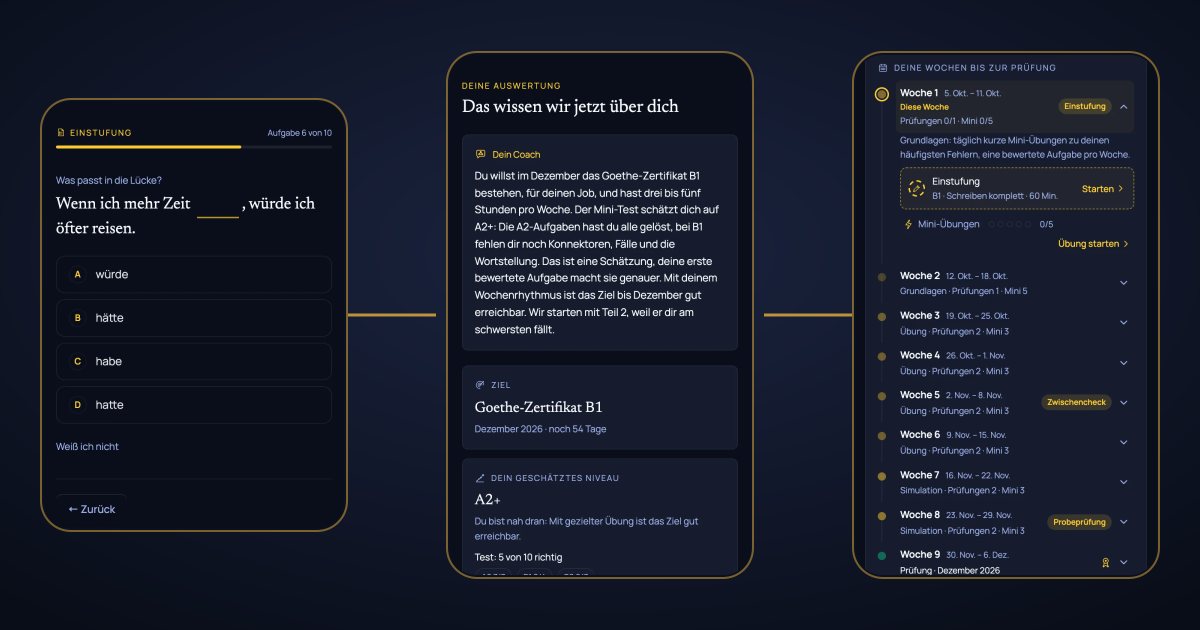
Transparency: GoetheCoach is our product. The images below are real recordings from the app, with an example learner (goal: B1 in December). You can also build the plan without the app; see further down. GoetheCoach is not affiliated with the Goethe-Institut.
The short answer
| What you need to know | What it decides in the plan |
|---|---|
| Goal: level, whole exam or single modules | Which tasks you practise and how long they are |
| Exam date (the month is enough) | How many weeks you have and when the mid-check and mock exam come |
| Time per week | How many evaluated tasks and micro-drills a week are realistic |
| Where you are now (mini test) | How big the gap to your goal is and how high the risk |
| Your weak spots | Where you start: the hardest part and your three most important problem areas |
Why "just start studying" doesn't work
Most learners start with whatever is in front of them: a textbook chapter, an app, a model exam. It feels productive, but it leaves three gaps:
- No starting point. Without a placement you often practise what you can already do and miss what is missing.
- No pace. Without a date there is no reason to practise this week rather than next. The work piles up in the last few days.
- No weekly goal. Without a concrete "this week: 2 texts, 3 drills" you never know whether you are on track.
A plan fixes all three, as long as it is built on your real data and adjusts when a week goes wrong.
Video: placement and study plan in 6 minutes (German)
Video transcript (German)
Die meisten lernen einfach drauflos … … und genau das ist der Fehler. Zuerst ein paar kurze Fragen: zu deinem Ziel und deiner Zeit. Dann ein Mini-Test mit 10 Aufgaben. Dauert nur ca. 3 Minuten. Danach weißt du endlich, wo du stehst und was dir noch fehlt. Daraus wird dein Lernplan: Woche für Woche bis zur Prüfung. Kostenlos auf goethecoach.de Dauert nur 6 Minuten.
Step 1: Set your goal, date and time
The questionnaire shows one question per screen, and most answers are a single tap. It asks about:
- Goal: level (A1–C2), whole exam or single parts, what you need the certificate for, whether passing is enough
- Date: exam month (or "I don't know yet"), whether you have registered, hours per week, when you study
- Background: previous exams, how long you have been learning German, how often you write in German
- Writing: which part is hardest, what you find difficult, what worries you most
- Style: native language, whether you have a teacher, whether your feedback should be strict or encouraging
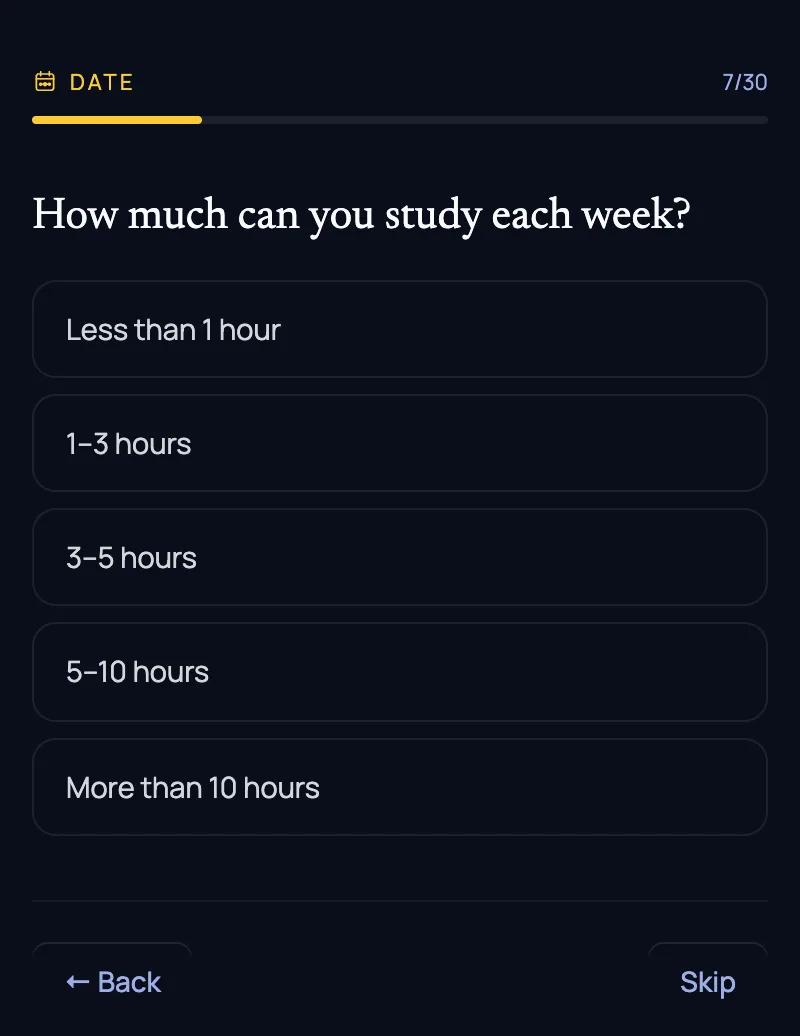
Real app screenshots, example learner: goal B1 in December.
You can skip any question and change all your answers later.
Step 2: Find your level with a mini test
Self-assessment is unreliable: many learners rate their writing too high or too low. That's why there is a short German placement test, about 3 minutes:
- 10 questions around your target level: 3 one level below, 4 at your level, 3 one level above (fill the gap, pick the correct sentence, pick the word that fits).
- 4 answers (A–D) plus "I don't know". Please don't guess: an honest "I don't know" makes the placement more accurate.
- No feedback during the test. You see the result in your evaluation, broken down by level (for example "A2 3/3 · B1 2/4 · B2 0/3").
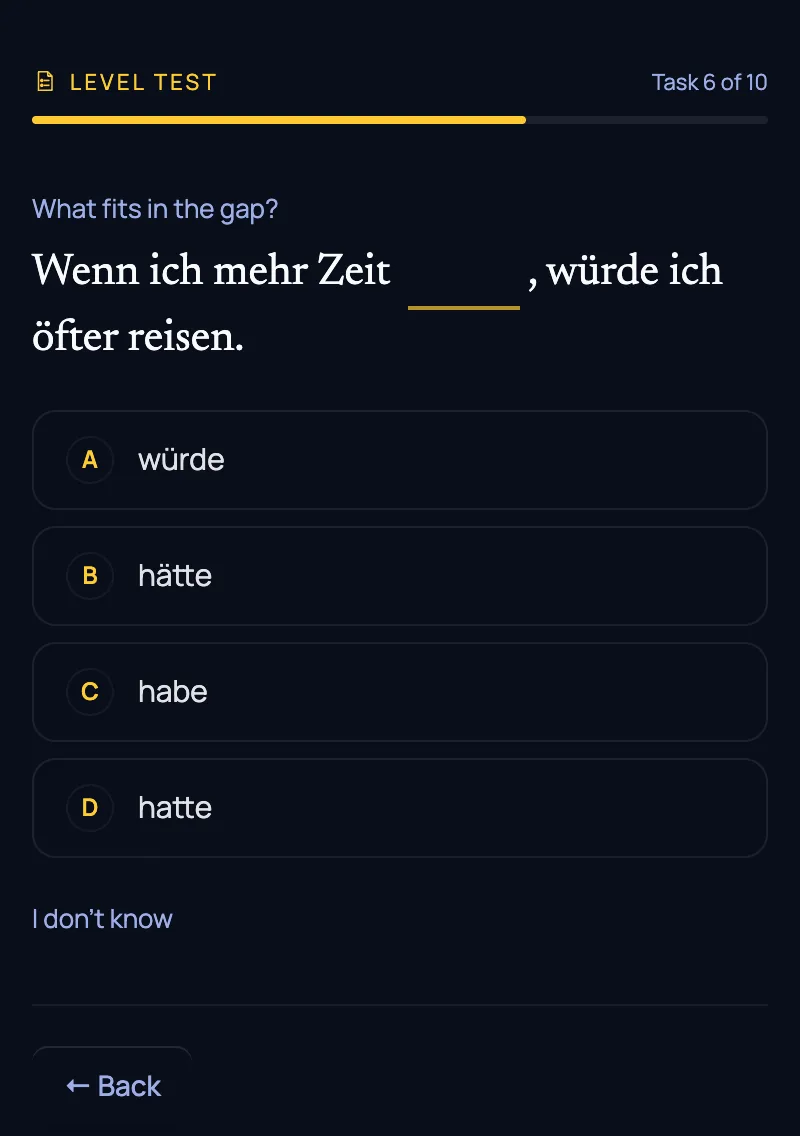
Real app screenshots, example learner: goal B1 in December.
You reach a level when you get at least 60% of its questions right and at least 50% of each level tested below it. A "+" (for example A2+) means you already got a third of the next level right. This is an estimate, not an exam result. Your first evaluated writing task makes it more precise.
Step 3: Read your evaluation
Right after the test you see "What we now know about you":
- Your coach: a short paragraph that sums up your answers
- Goal: exam, month and the days left
- Your estimated level with the test score and where it puts you: already at your target level, close, still a gap, or a long way to go
- Risk (low, medium, high) with the reasons: a big gap to your goal, little time before the exam, less than 1 hour a week, a second attempt
- Your weekly rhythm: evaluated tasks, micro-drills and hours per week, based on your time
- What we'll focus on first: your three most important problem areas and the writing part you feel least confident in
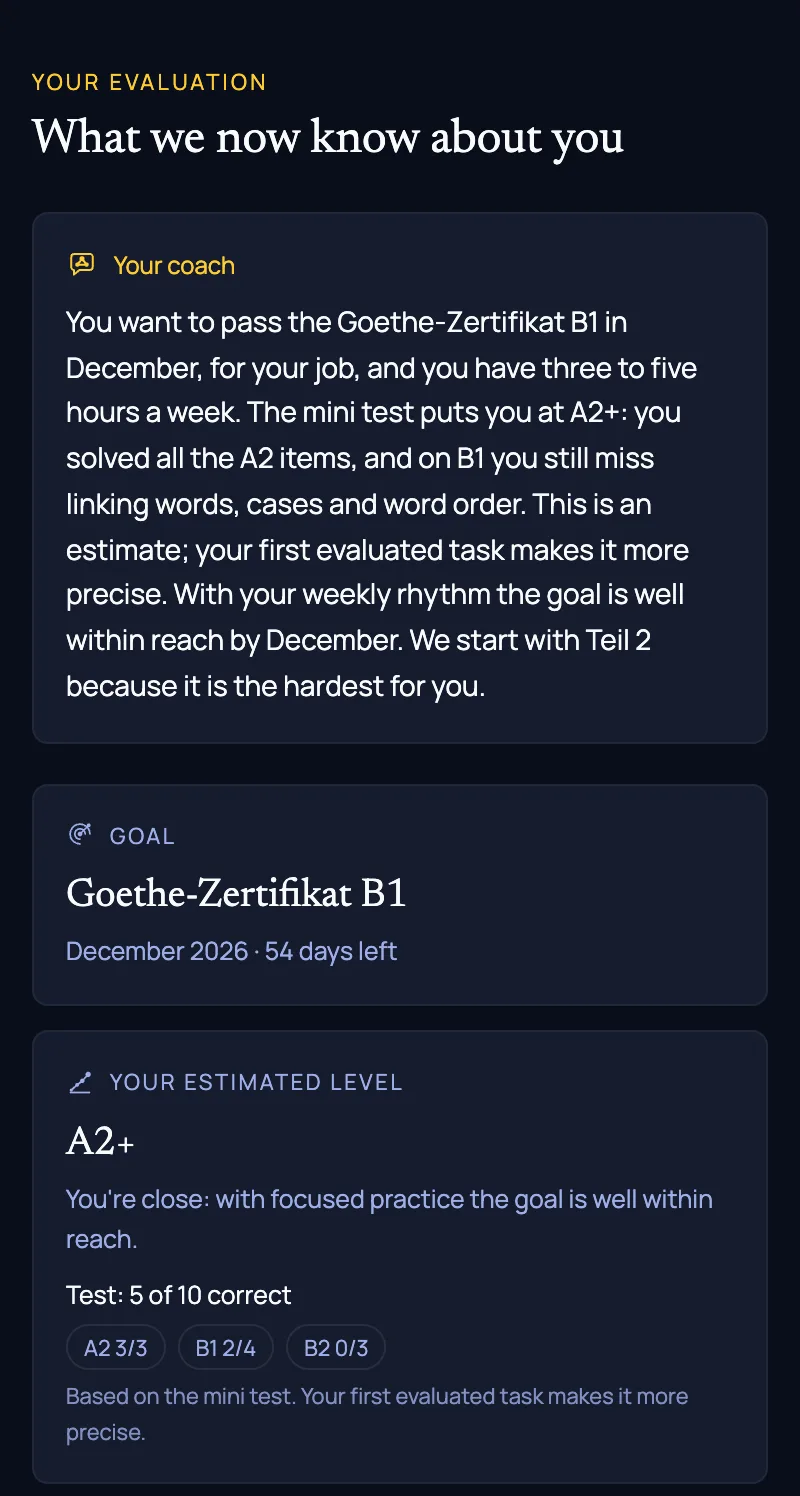
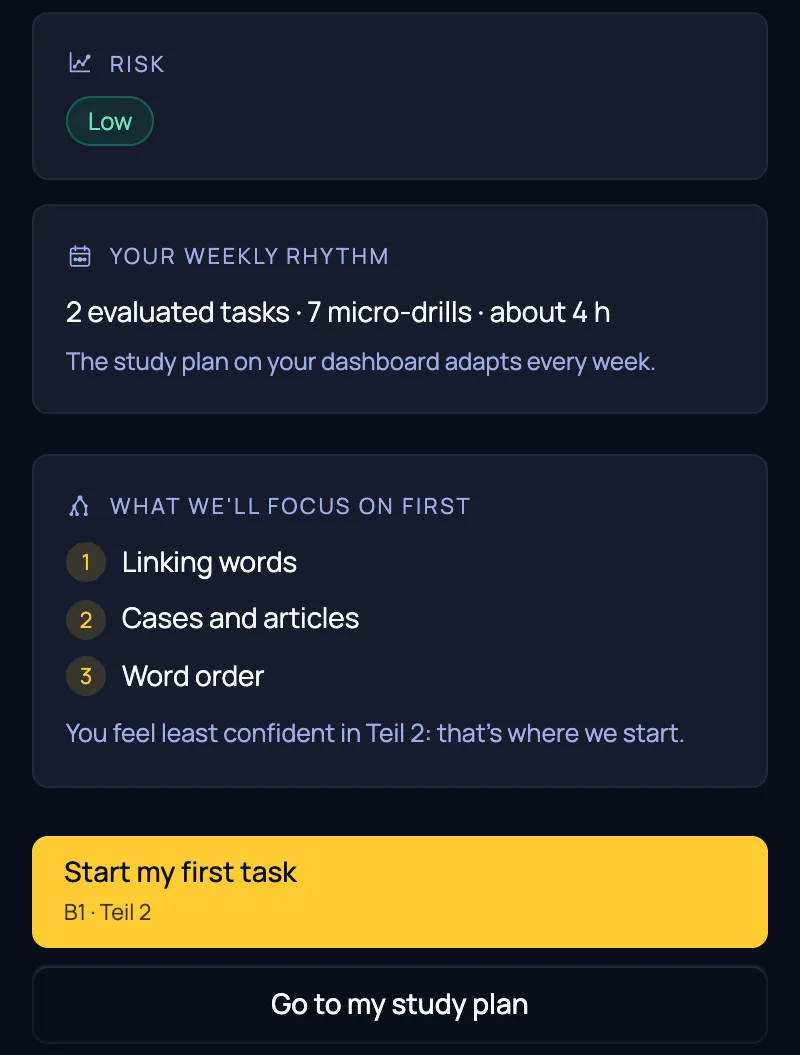
Real app screenshots, example learner: goal B1 in December.
From here you either start your first task straight away (in the example: B1, Teil 2) or go to your study plan.
Step 4: Your study plan, week by week
From your exam date and your activity, GoetheCoach builds a plan from Monday to Sunday, at most 12 weeks before the exam week. It has phases:
| Phase | When | Evaluated tasks / micro-drills per week |
|---|---|---|
| Foundations | the first ~40% of the weeks | 1 / 5 |
| Practice | after that, until the simulation | 2 / 3 |
| Simulation | the 2 weeks before the exam week | 2 / 3 |
| Exam week | the last week | 0 / 3 |
| Sprint | when only 1–2 weeks are left | 2 / 4 |
On top of that come three milestones: the placement in week 1 (the full writing exam, if you have no evaluated task yet), a mid-check in plans of 6 weeks or more, and a mock exam one week before the date, with the real time limit.
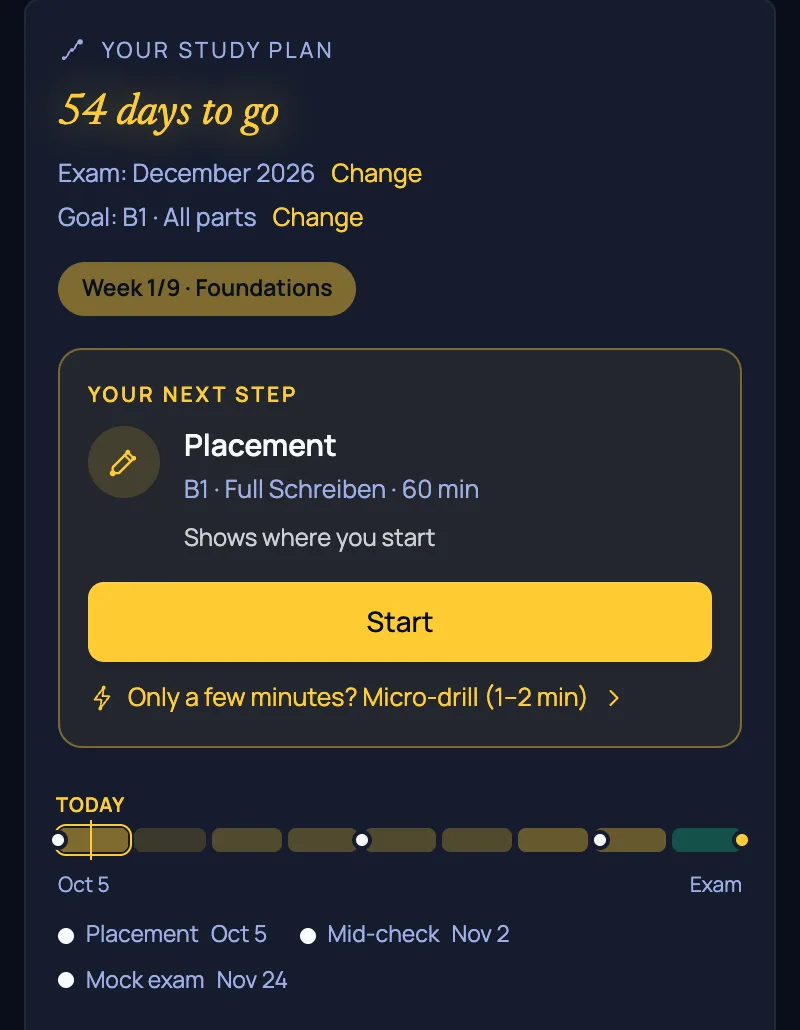
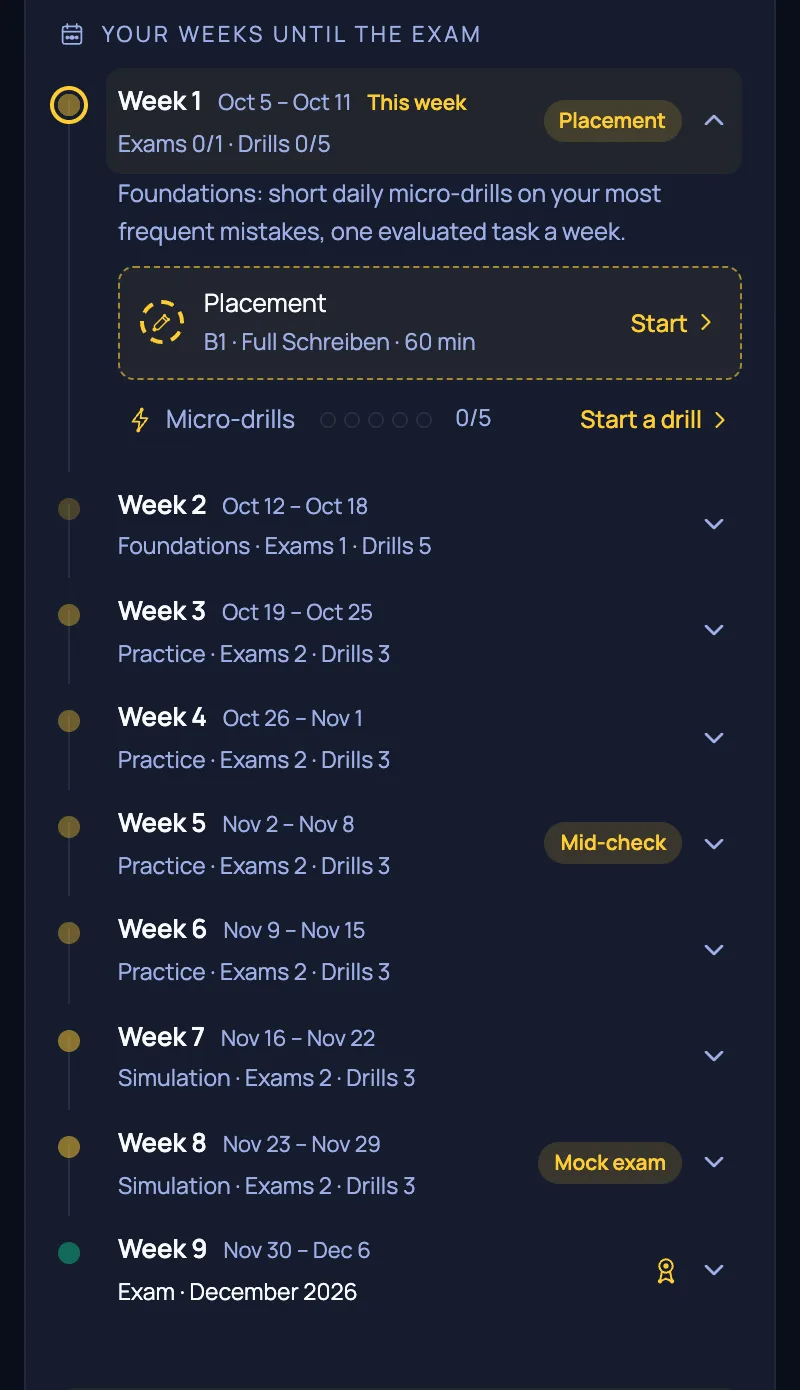
Real app screenshots, example learner: goal B1 in December.
At the top you always see your next step: the one task that is due now, with level, part, text type and word count, plus a 1–2 minute micro-drill as the short alternative. Each week opens with a tap, and tapping a task starts it.
Example: B1 in December, 9 weeks
This is the plan for the example learner (plan from October 5, exam in December):
| Weeks | Phase | Per week | Milestone |
|---|---|---|---|
| 1–2 | Foundations | 1 task, 5 micro-drills | Week 1: placement (full writing exam, 60 min) |
| 3–6 | Practice | 2 tasks, 3 micro-drills | Week 5: mid-check |
| 7–8 | Simulation | 2 tasks, 3 micro-drills | Week 8: mock exam |
| 9 | Exam week | 3 micro-drills only | Exam |
When a week goes wrong
The plan is not stored. It is recalculated from your date and your real activity every time you open it. Missed tasks move to the next open weeks, never more than 3 a week and never into the exam week. If your exam is more than 12 weeks away, you get a light rhythm until the plan starts: one evaluated task every other week and 3 micro-drills.
Build the plan yourself, without the app
The logic works on paper too:
- Count the weeks: from next Monday to your exam week (if it's more than 12 weeks, start lightly).
- Find your level: in week 1, write a full writing exam with the real time limit (B1: 60 minutes) and have it marked against the four Goethe criteria.
- Split into phases: the first ~40% foundations (short daily drills on your most frequent mistakes, one text a week), then practice (two texts a week), and the last two weeks before the exam a simulation under exam conditions.
- Set milestones: a mid-check halfway, a mock exam one week before the date.
- Agree a catch-up rule: spread anything you miss over the next weeks, at most 3 texts a week, and keep the exam week light.
The hardest part without an app is step 2: you need someone who marks your texts against the Goethe criteria and tells you which Leitpunkt is missing.
What the plan doesn't cover
- Writing only. GoetheCoach trains the Schreiben module, with micro-drills on grammar and vocabulary. For reading, listening and speaking you need other materials.
- No official grade. The placement and evaluations are practice estimates based on the official criteria; only Goethe-Institut examiners grade the exam.
- More than the free evaluations. A plan over several weeks often includes more evaluated tasks than the 10 free ones. The plan says so openly, in the example: "Planned until the exam: 14 evaluated tasks, 10 of them free."
How to start
- Sign up for free: the questionnaire starts automatically.
- Enter your goal, date and time (about 3 minutes).
- Take the mini test without guessing (about 3 minutes).
- Read your evaluation and start your first task.
- Every week, do the next step in your plan.
Frequently asked questions
How long do the questionnaire and placement test take?
About 6 minutes: roughly 3 minutes for the questions and 3 minutes for the 10-question mini test.
Is the placement test free?
Yes. The questionnaire, mini test, evaluation and study plan are free once you have signed up for free. Your first 10 evaluated writing tasks are free as well.
How accurate is the placement?
It is an estimate from 10 questions around your target level. Your first evaluated writing task makes it more precise, which is why the plan puts the placement in week 1.
I don't have an exam date yet. Do I still get a plan?
Yes: you get a weekly rhythm based on your time per week. As soon as you enter a month, the plan with phases and milestones appears. The month is enough; the exact day is optional.
What happens if I miss a week?
The plan recalculates: missed tasks are spread over the next weeks, at most 3 a week, and the exam week stays free.
Does this work for B2 and C1?
Yes. The questionnaire and mini test cover A1 to C2; the test always uses questions one level below, at and above your target level. For B1, B2 and C1 the questionnaire also asks which writing part you find hardest.
Can I change my answers later?
Yes, at any time with "Change answers" in your evaluation. You change your date and goal directly in your study plan.
Find out where you stand in 6 minutes
A few short questions, a 10-question mini test, then your evaluation and your study plan until the exam. Free.
Start free