
Transparency: GoetheCoach is our product and is not affiliated with the Goethe-Institut. The numbers in this article come from our own questionnaires, practice data and forum conversations (as of October 14, 2026). They aren't representative, but they show clear patterns; we say what they show and what they don't. The method works without the app too.
The short answer
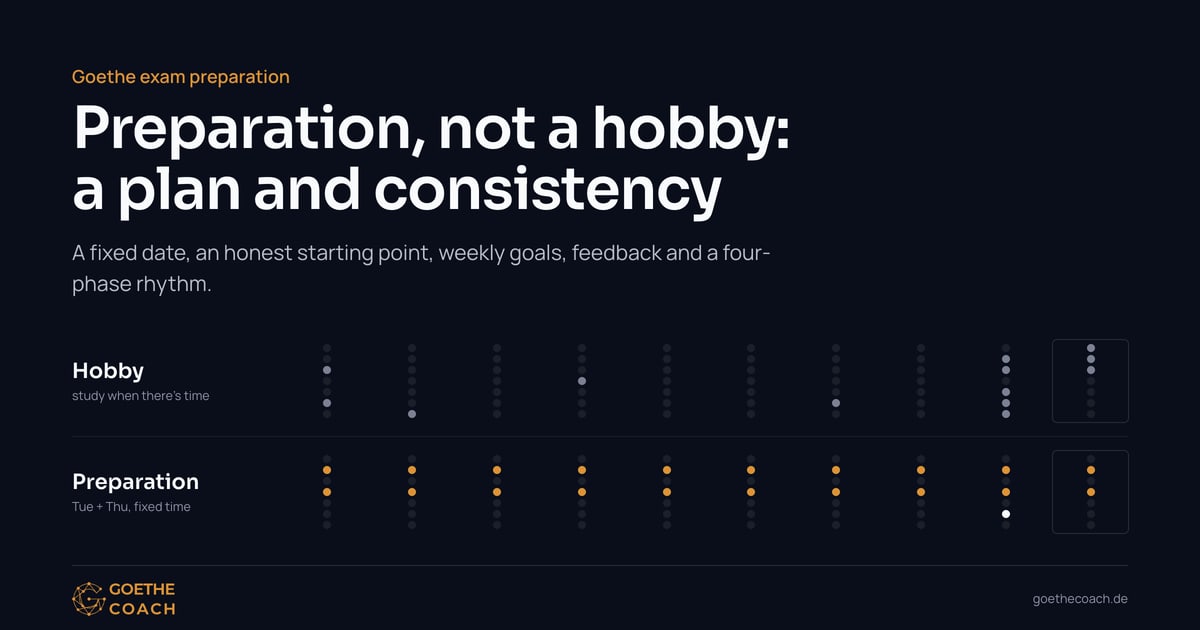
| Hobby | Preparation |
|---|---|
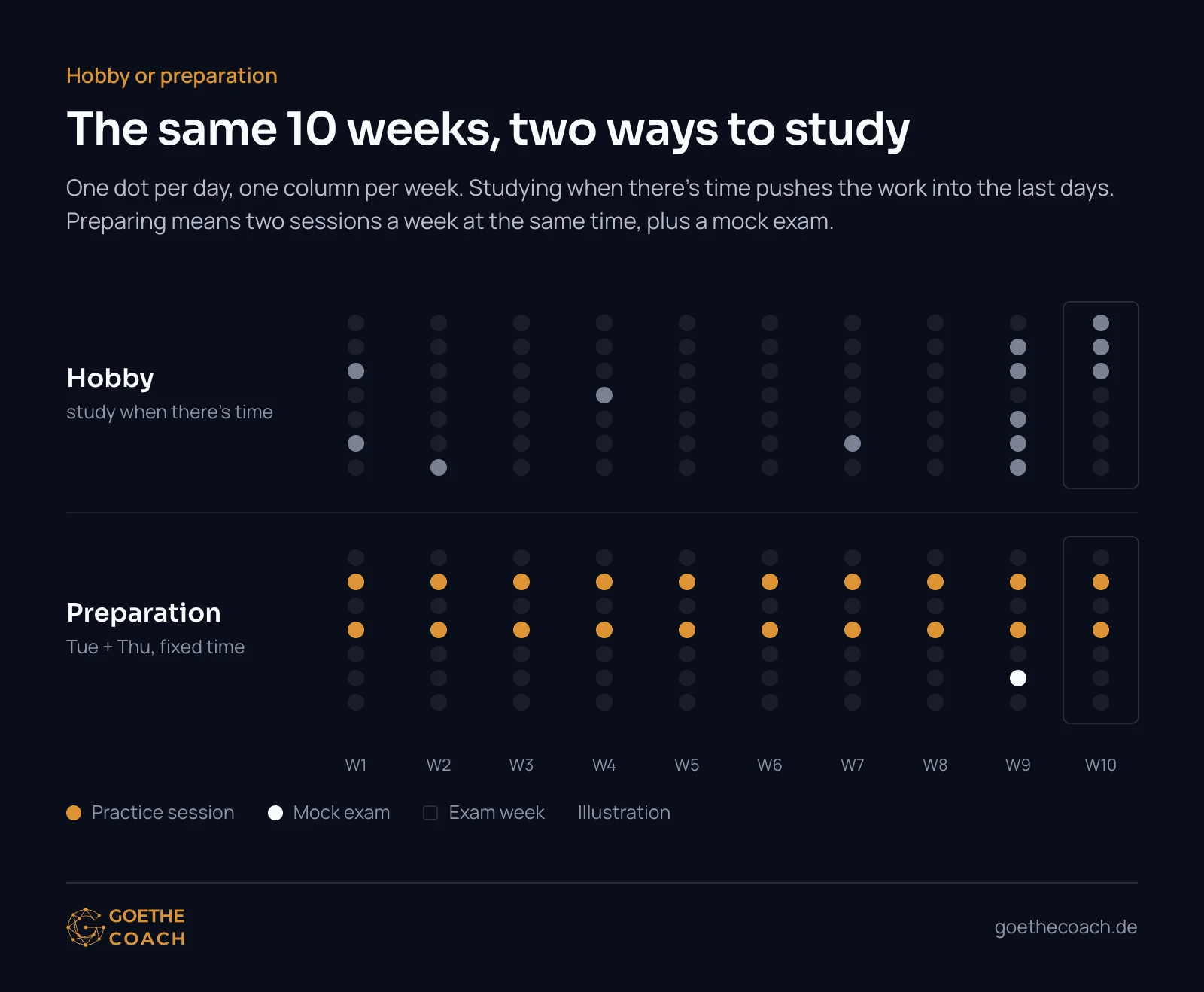
| Studying when there's time | Fixed study slots in your calendar, e.g. Tue + Thu, 7 pm |
| "Sometime in spring" | An exam date, at least the month |
| Feeling: "My German is fine" | A measured starting point: level, gap to the goal, weak spots |
| Model tests until they run out | A weekly goal: this many graded texts, this many short drills |
| A correction that says "looks good" | Feedback by the four Goethe criteria, with Leitpunkte and word count |
| One missed week = plan broken | Missed work is spread over the next weeks |
| The last week: panic | A mock exam under exam conditions 7 days before |
The difference isn't effort, it's structure. When you're prepared, you know what to do every week and you notice early when something isn't working.
What we hear in more than 250 conversations
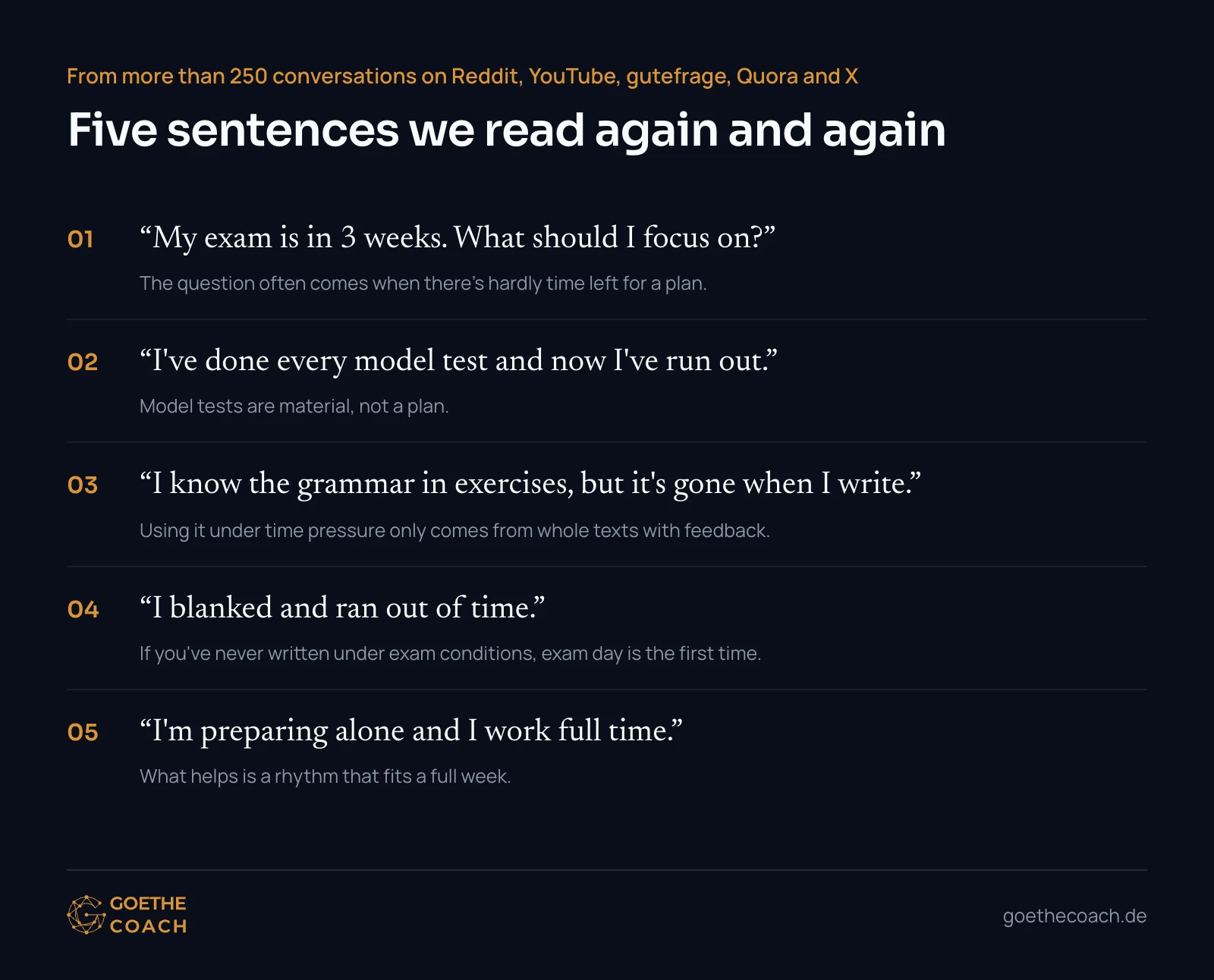
Since September we have been reading and answering questions about the Goethe exam on Reddit, YouTube, gutefrage.net, Quora and X, around 250 threads. Five sentences come up again and again, almost word for word:
- "My exam is in 3 weeks, what should I focus on?" The question often comes when there's hardly any time left for a plan. Three weeks are enough to secure exam technique, but rarely enough to make up a whole level.
- "I've done every model test in the book and now I've run out." Model tests are material, not a plan. Without feedback, the tenth model test shows the same mistakes as the first.
- "I know the grammar in exercises, but it's gone when I write." Knowing a rule and using it under time pressure are two different skills. You only build the second one by writing whole texts regularly and getting them corrected.
- "I blanked in the exam and ran out of time." If you've never written under exam conditions, the time limit hits you for the first time on exam day.
- "I'm preparing alone and I work full time." An extra dose of motivation won't fix this. A rhythm that fits a full week will.
One YouTube title sums it up well: "I want to pass B1" is a goal, not a plan.
What the questionnaires tell us
Everyone who starts with GoetheCoach fills in a short questionnaire: goal, date, time per week, history, weak spots. The answers aren't representative of all test-takers, but the patterns are clear:
- High goals, little time: almost 6 in 10 don't just want to pass, they want "the best result". At the same time, almost half plan less than 3 hours a week, and about one in seven less than one hour.
- The date is often already set: more than half were already registered; with those about to register, it's two in three. Almost all exam dates were within the next five months.
- The biggest worries aren't grammar questions: in their own words they named blanking out, "no ideas on the topic", "not enough time" and "not answering every point well". These are worries you can shrink by practising under exam conditions.
- The most common weak spots in writing: more than half name vocabulary, almost half text structure and cases, and more than a third each verbs, time and ideas.
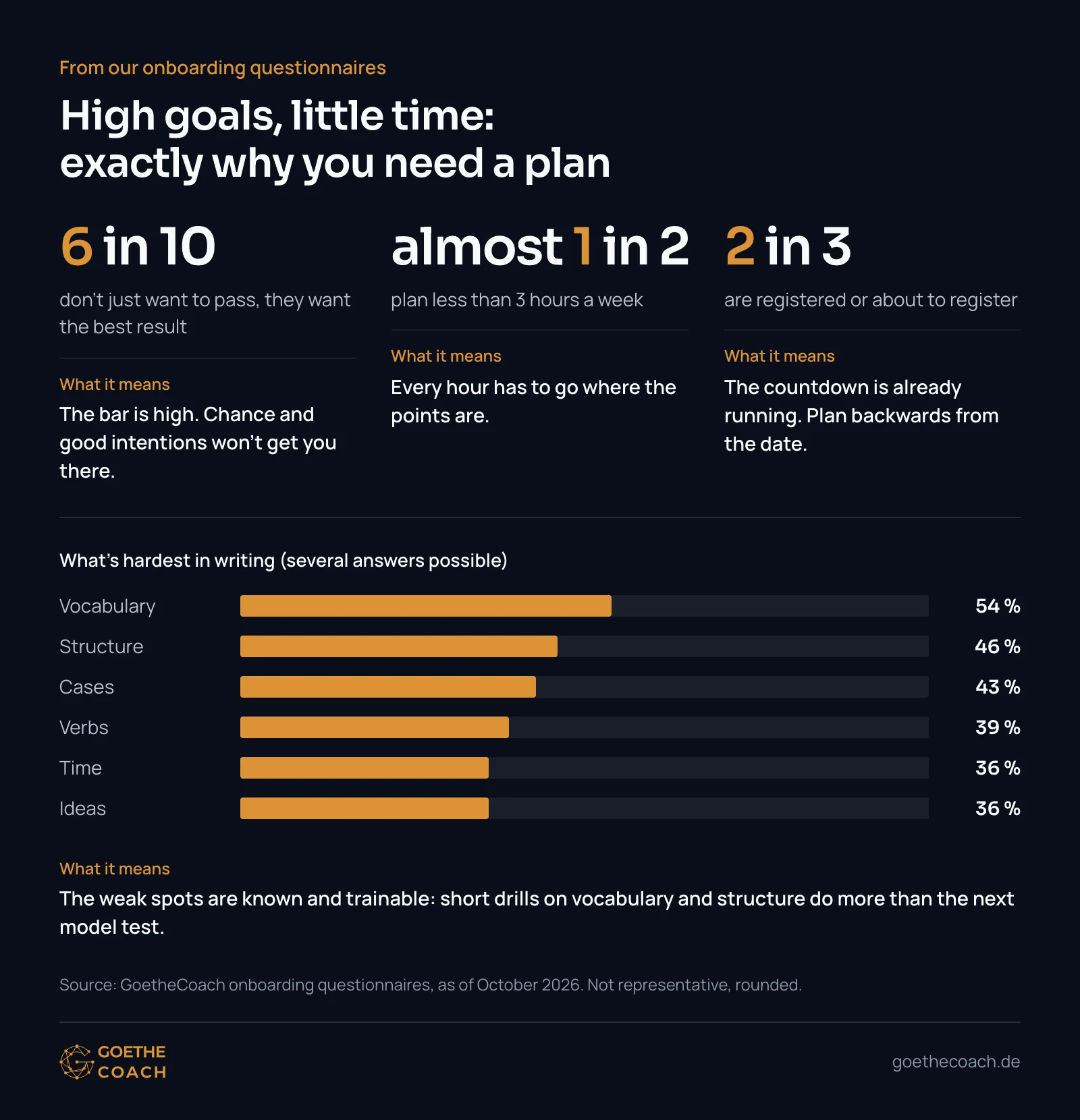
The gap between "best result" and "under 3 hours a week" isn't a criticism. It shows why a plan matters: when time is short, every hour has to go where the points are.
What we see in learners who keep going
People who come back regularly make visible progress, often faster than they expect. Three examples from our practice data, anonymised (percentages are GoetheCoach estimates, not official Goethe results):
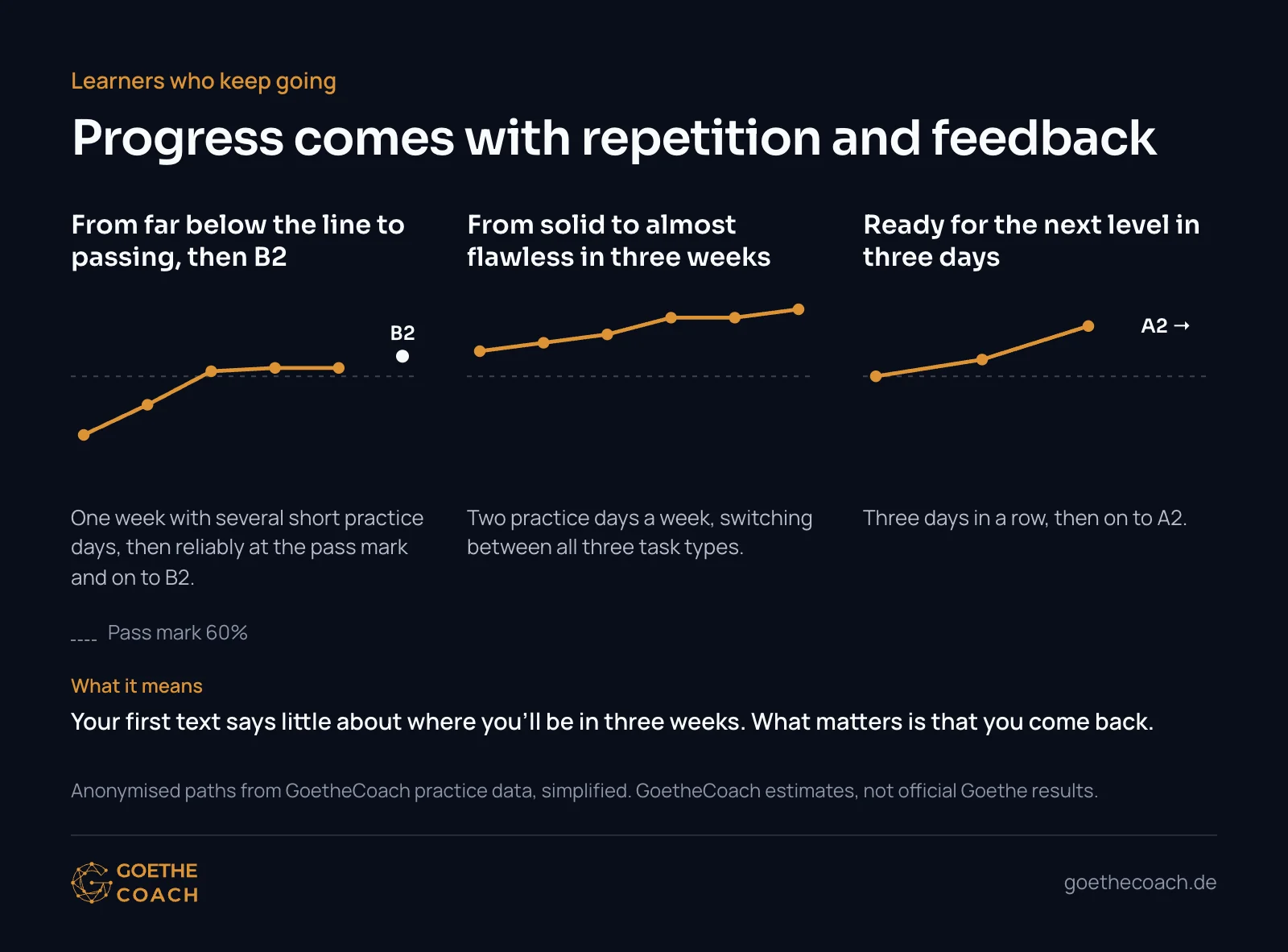
From far below the line to passing, then on to B2
The first B1 text was far below the pass mark. After one week with several short practice days, the texts were reaching the pass mark reliably. Soon after, the learner moved up to B2 and passed their first forum post in practice.
From solid to almost flawless in three weeks
A good start at B1, then two practice days a week, switching between all three task types. After three weeks, the texts in all three parts scored above 90%.
Ready for the next level in three days
Three practice days in a row, and the A1 short messages rose from a narrow pass to 90%. Then it was on to A2.
These are individual cases, not a representative analysis. But they show the same pattern: progress didn't come from the first attempt, it came from repeated practice with feedback.
The rhythm: four phases until the exam
A good plan counts backwards from the exam date. This is the default plan GoetheCoach suggests at 1–3 hours a week; you can also build it on paper:
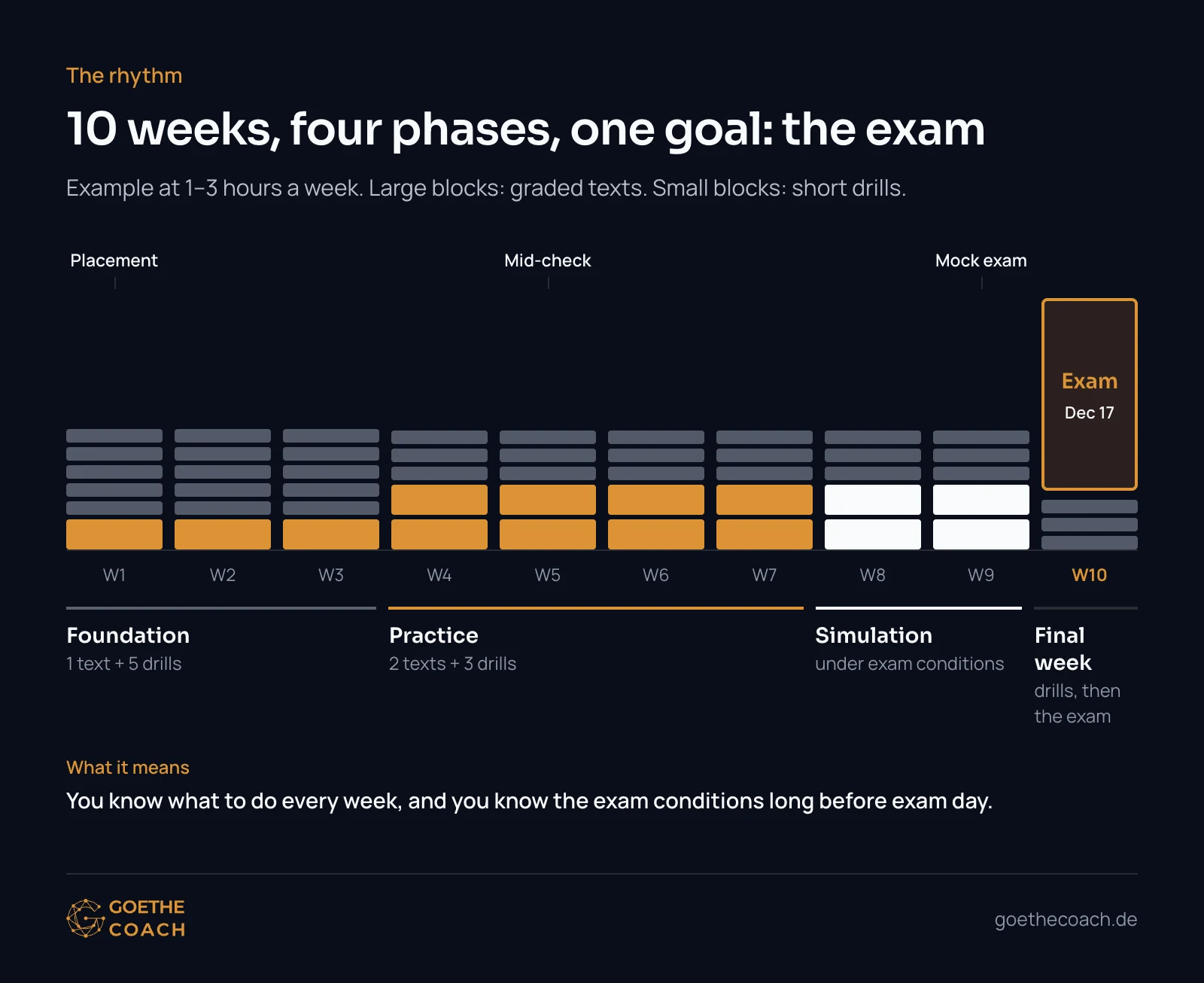
| Phase | When | Per week | Purpose |
|---|---|---|---|
| Foundation | the first ~40% of the weeks before the simulation | 1 graded text, 5 short drills | close your weak spots |
| Practice | the weeks after that | 2 graded texts, 3 short drills | whole tasks, all parts, apply the feedback |
| Simulation | the last 2 weeks before exam week | 2 texts under exam conditions, 3 short drills | time limit, no help, mock exam 7 days before |
| Exam week | the week of the exam | 3 short drills, no new texts | review, rest, get your documents ready |
Three rules make the plan robust:
- Missed isn't lost. If a week falls through, spread the missing texts over the next weeks, but never more than three a week and never into exam week.
- Time sets the amount, not the goal. At 5–10 hours a week more texts and drills fit in, at under an hour fewer. If your goal is more than one level above where you are, you need more foundation weeks or a later date.
- Fixed slots beat good intentions. Two slots a week in your calendar, e.g. Tuesday and Thursday at 7 pm, last longer than "I'll study when I have time".
There's more on building the plan and the placement test in the Goethe exam study plan. If only two weeks are left, use the B2 14-day plan.
How to turn studying into preparation, with or without an app
- Set the date. Book the exam or at least pick a month. The Goethe exam dates 2026 guide helps you find one.
- Measure your starting point. Write a model test under the time limit and have it graded honestly. How to find your German level explains how.
- Add two fixed study slots. As a recurring event in your calendar, not as an intention.
- One clear goal per week. For example: write 2 texts, do 3 short drills on your weak spots.
- Feedback against a fixed scale. The four criteria (task completion, coherence, vocabulary, structures), every Leitpunkt on its own, count the words yourself. How Goethe writing is scored shows how strict the marking is.
- Keep a mistake list. Recurring mistakes with your own sentence and the correction. Practise one of them on purpose every week.
- Look back briefly every Monday. Goal met? If not, spread the missing tasks, don't just tick them off.
- Mock exam 7 days before. All parts, with the time limit, no help. After that only small fixes.
Where GoetheCoach helps
GoetheCoach takes over the parts that are hardest to keep up on your own: measuring, planning, feedback and reminders. It focuses on writing, because that's the part where, without feedback, you notice least where you stand. We don't do speaking practice.
- Assess: a short questionnaire and a 10-question mini test around your target level show your starting point and weak spots, in about 6 minutes.
- Plan: your date, time per week and the gap to your goal turn into a week-by-week plan with the four phases, a mid-check and a mock exam.
- Practise: real exam tasks for your level and short drills aimed at your own mistakes.
- Grade: every text is graded by the four Goethe criteria, every Leitpunkt is checked and the words are counted, with explanations and fixes inside your own text.
- Catch up: missed tasks move into the next weeks automatically.
- A gentle nudge: your practice slots appear as a calendar subscription in your own calendar, at the time you choose in the questionnaire. Every Monday a short email covers how last week went, what's on this week and one tip from your own text. A week before the exam an email reminds you about the mock exam, and the evening before you get three last tips. Never more than one coach email within three days.
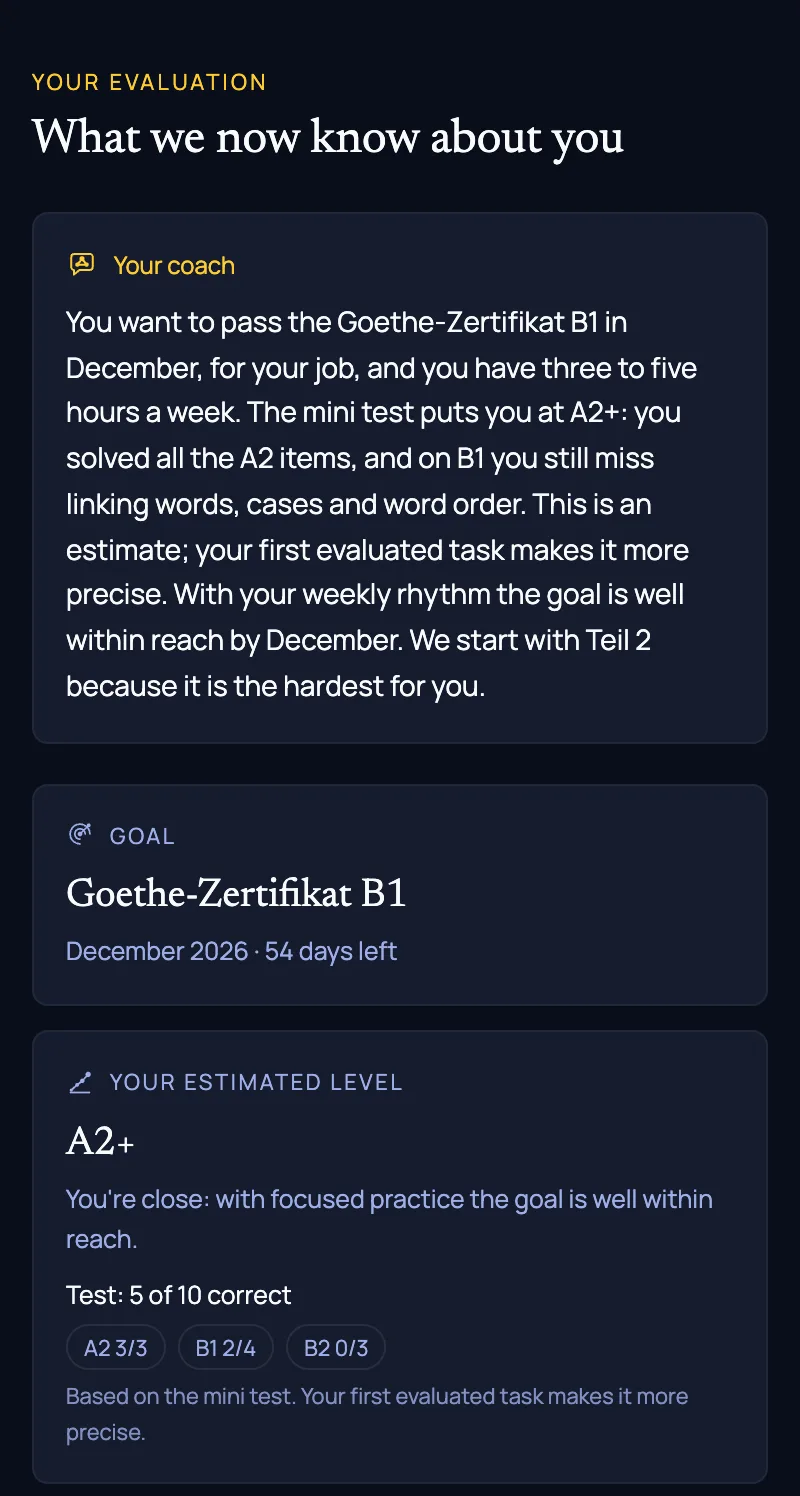
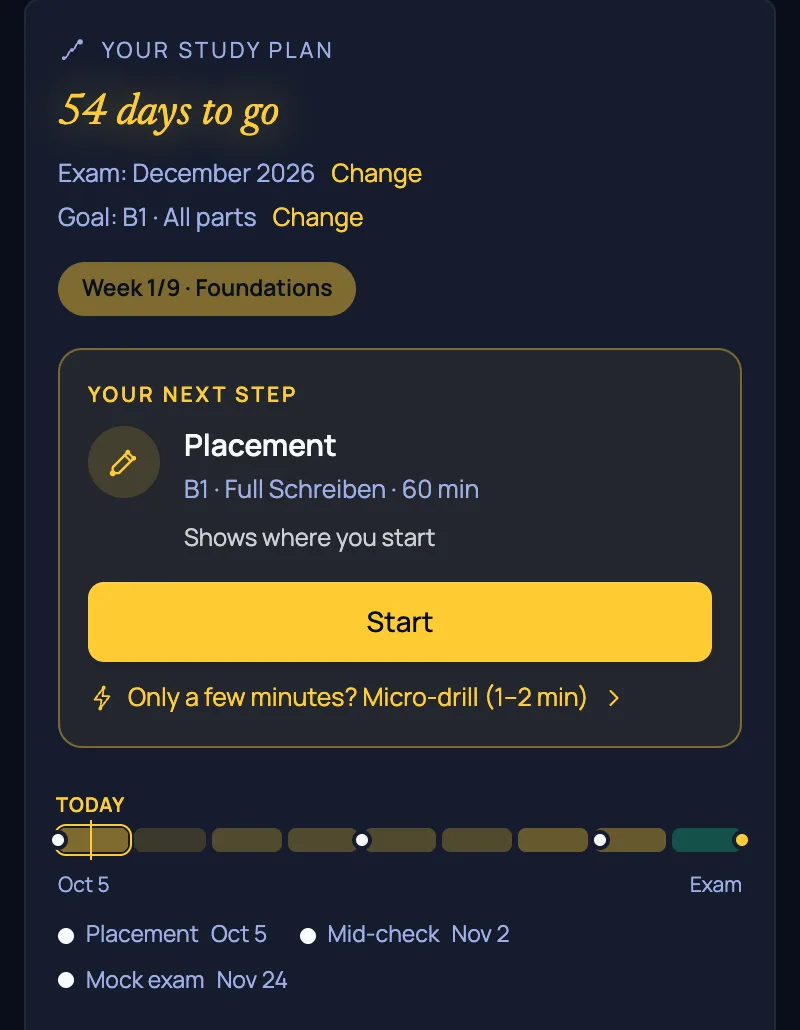
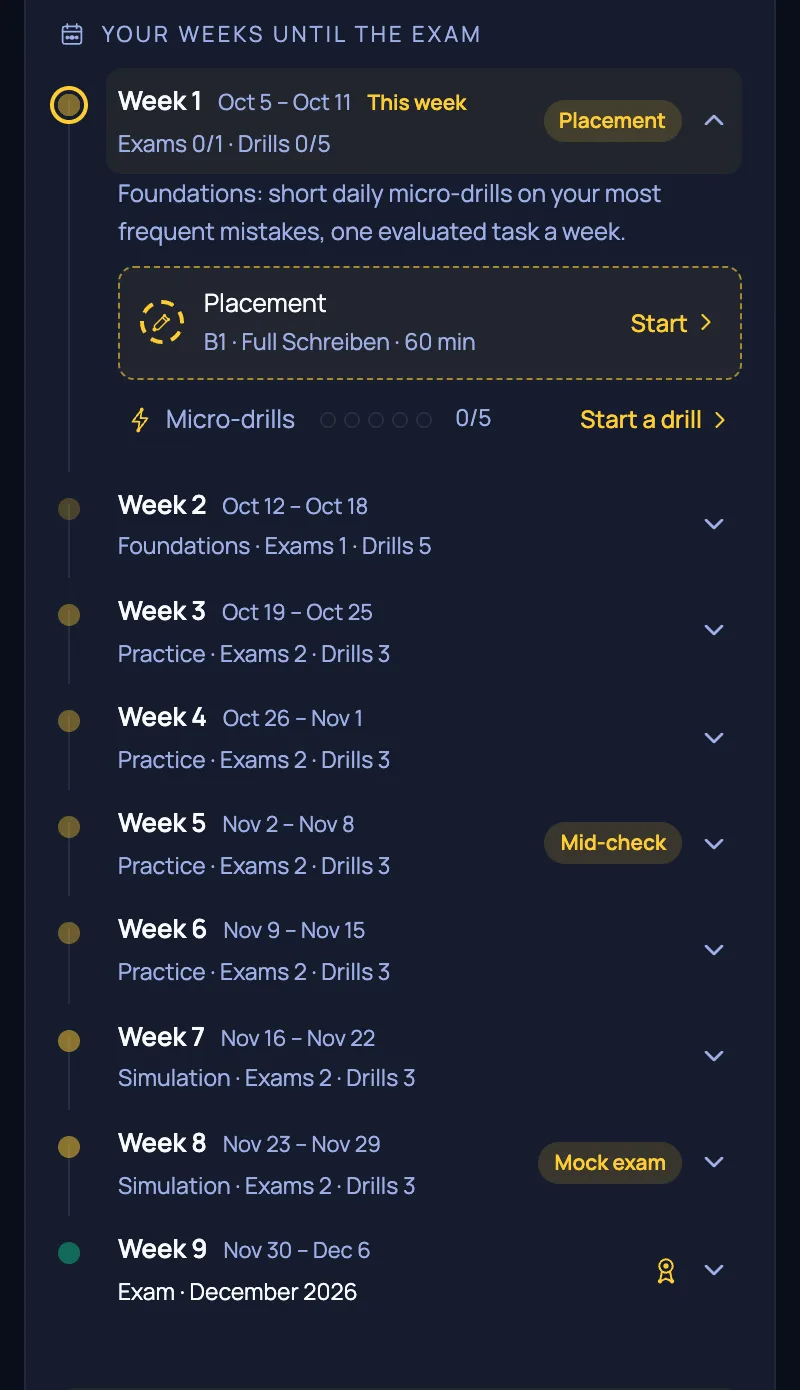
Real app screenshots, example learner: goal B1 in December.
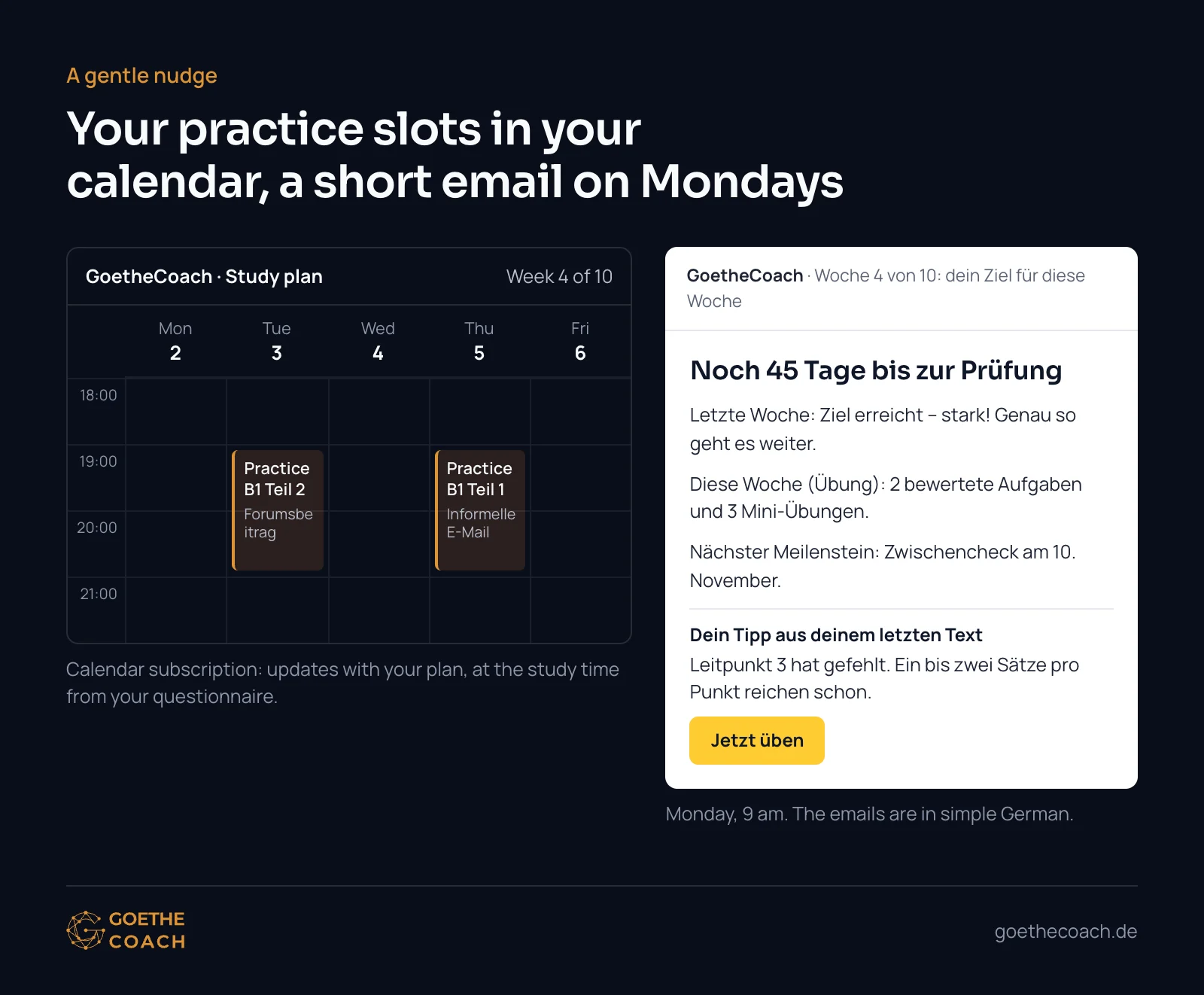
Enough to keep it preparation rather than a hobby. Not so much that it gets annoying.
Frequently asked questions
How long should I prepare for the Goethe exam?
It depends on the gap between where you are today and your target level. If you're already close, a few weeks with a fixed rhythm are often enough. If you're more than a level away, plan several months or choose a later date. Measure your starting point first, then count backwards from the exam date.
How many hours a week should I study?
Consistency matters more than the number. Two fixed sessions a week, each with one graded text or short drills, are a good start. In our questionnaires almost half planned under 3 hours a week; that can be enough if the gap to your goal is small and the time goes straight into your weak spots.
Are 3 weeks enough for the Goethe exam?
Three weeks are enough to secure exam technique: cover every Leitpunkt, manage your time, write a mock exam. You rarely make up a whole level in three weeks. If your starting test is well below the goal, a later date is often the better decision.
Can I prepare for the Goethe exam on my own?
Yes, many people do, often alongside work or university. What's usually missing on your own isn't material but structure and honest feedback: fixed study slots, a weekly goal, and grading by the Goethe criteria instead of "looks good".
What if I miss a week?
Don't start over and don't drop the plan. Spread the missing tasks over the next weeks, at most three graded texts a week, and keep exam week free. If several weeks are missing, check whether the date is still realistic.
Is it enough to just do model tests?
Model tests are good material for learning the format and practising under the time limit. Without feedback, though, you repeat the same mistakes. Write fewer model tests, have each one graded carefully, then practise the mistakes that keep coming back.
Where do you stand today?
The Prüfungs-Check shows you in a few minutes how far you are from your exam, and it's the starting point for your plan. Free, no account.
Start the Prüfungs-Check