
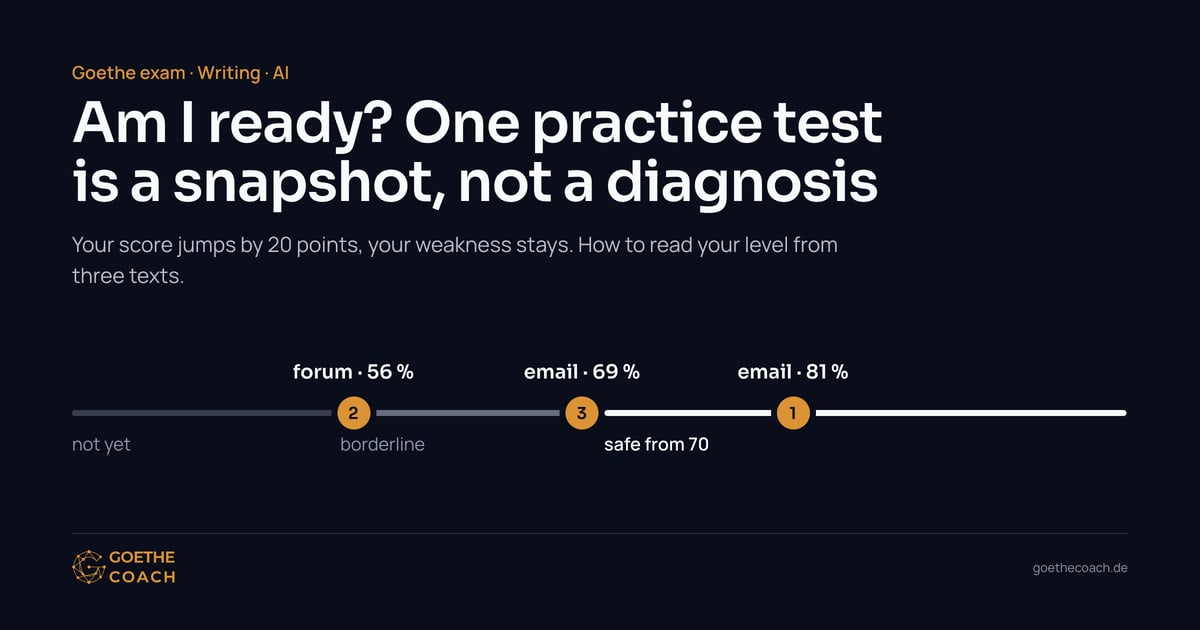
This page is for you if you wrote a practice text, an AI gave you 80 points or more, and now you want to know: can I book the exam? Short answer: one result is not enough to tell. Three results and a pattern are.
Why does a good AI score feel so safe?
A good AI score feels safe because it looks like a grade: a number, four criteria, a friendly summary. But it is only a snapshot. It shows one text on one topic on one day, and the camera is usually set to flattering.
Studies show that language models grade essays more leniently than teachers (Seßler et al. 2025) and overrate short, polished texts (Mathew et al. 2026, preprint). In our own test, ChatGPT gave a B2 Forumsbeitrag with one missing Leitpunkt 82–89 points five times and said every Leitpunkt was covered.
We are not perfect either: when our AI grades the same text several times, the result usually stays within about ±5 points. So even a strict grader moves a little. A single number is an estimate, not a diagnosis.
How much does a practice score move from text to text?
Much more than the grading itself. We looked at a few dozen learners with at least three graded texts and compared their first three. The median gap between the best and the weakest text was 20 points. For more than 8 in 10 it was at least 10 points, for more than half at least 20.
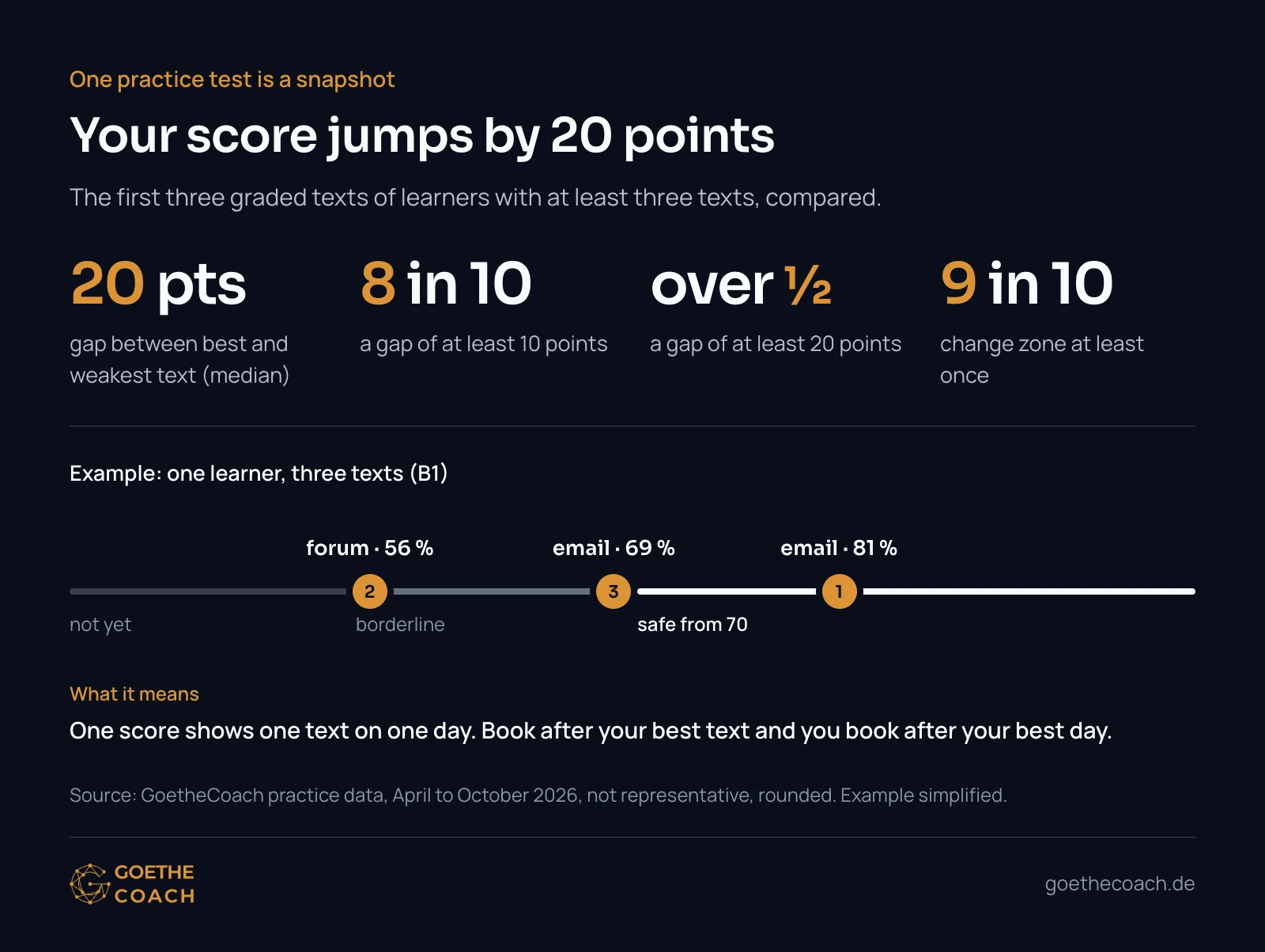
Almost nine in ten changed zone at least once within their first three texts: from "safe" (70% and up) to "borderline" (55–69%) or "not yet" (below 55%) and back.
What it means: if you book after one good text, you may be booking after your best day. If you give up after one bad text, you may be giving up after your worst. Not representative, but a clear pattern.
Why? Every topic suits you differently, and so does every text type (informal email, Forumsbeitrag, formal message). Add your form on the day, time pressure and whether you wrote without help.
What stays the same? Your weakest criterion
The score jumps, the weakness stays. For a good two thirds of learners, the same Goethe criterion was the weakest in at least two of their three texts.
Goethe writing is scored on four criteria: Aufgabenerfüllung (all Leitpunkte, the right text type and register), Kohärenz (structure, paragraphs, connectors), Wortschatz (vocabulary) and Strukturen (grammar). Which one was most often the weakest?
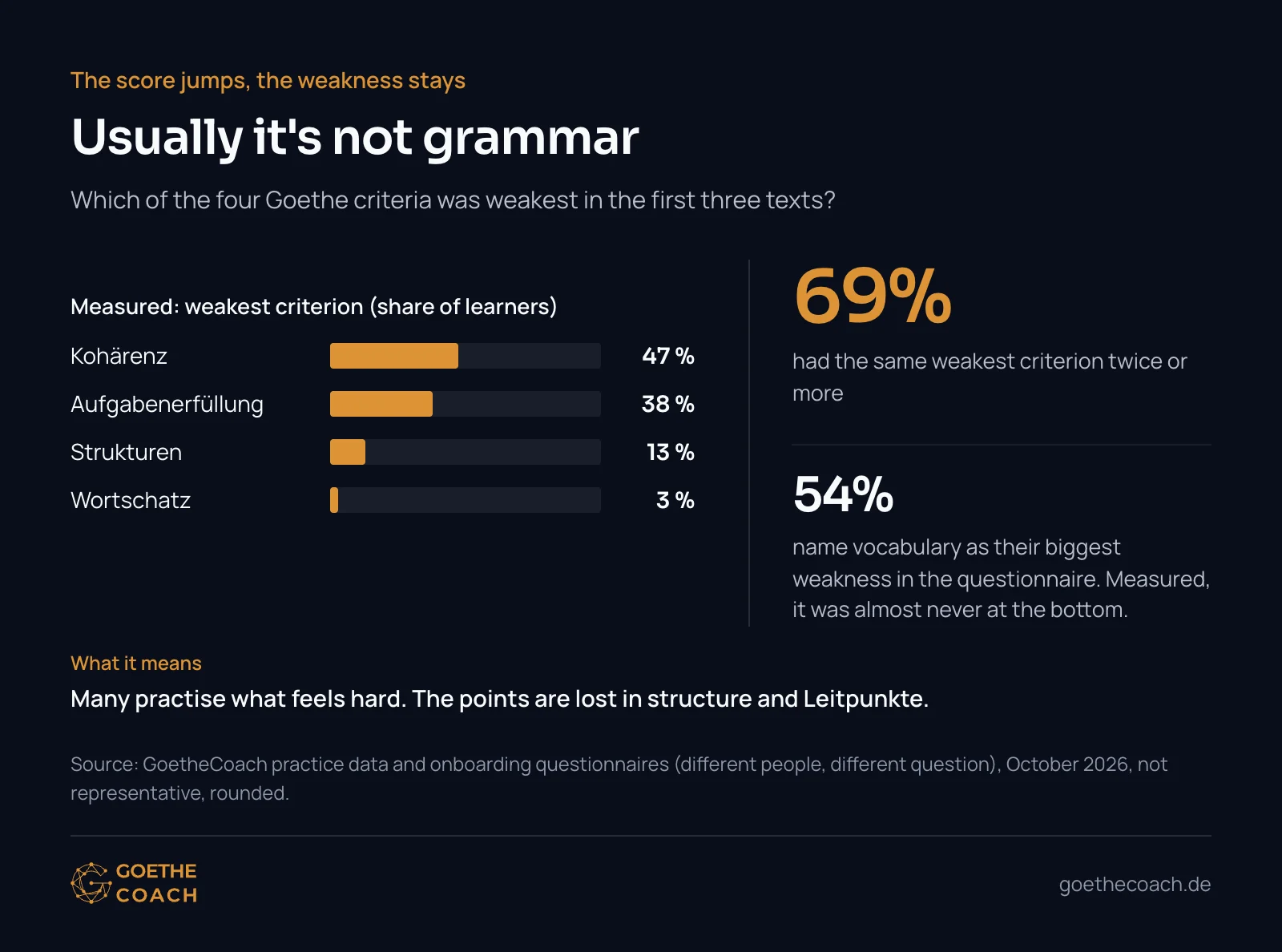
Most often it was not grammar but Kohärenz and Aufgabenerfüllung: together more than 8 in 10 learners. Strukturen was the weakest criterion for about one in ten, Wortschatz almost never.
What does that look like? A simple B1 example, twice without a single grammar mistake (at B2 it works the same, with longer sentences):
- "Ich finde Sport gut. Sport ist gesund. Ich habe wenig Zeit. Ich gehe nicht oft ins Fitnessstudio."
- "Ich finde Sport gut, weil er gesund ist. Trotzdem gehe ich nicht oft ins Fitnessstudio, denn ich habe wenig Zeit."
The first one is correct, but it only lists. The second connects the ideas and shows how they relate. That is exactly what Kohärenz scores.
Compare that with our onboarding questionnaires: there, more than half name vocabulary as their biggest weakness in writing. Different people and a different question, but the direction is clear. Many learners practise what feels hard. The points are lost somewhere else.
If you use ChatGPT: how to ask for the Goethe criteria
An AI can help if you give it the right job. "Grade my text strictly" is not enough. Give it the task, the real criteria with point values and a fixed output.
For B1, Teil 1 (email):
You are grading a text for the Goethe-Zertifikat B1, Schreiben Teil 1 (email, about 80 words). Here is the task with all three content points: [paste task]. Score the four Goethe criteria, each 0, 2.5, 5, 7.5 or 10 points: Erfüllung, Kohärenz, Wortschatz, Strukturen. Check each content point separately: present, only hinted at, or missing, quoting the sentence from my text as evidence. At the end give only: points per criterion, the total out of 40, and which criterion is weakest. No praise. Do not rewrite my text.
For B2, Teil 1 (Forumsbeitrag):
You are grading a text for the Goethe-Zertifikat B2, Schreiben Teil 1 (Forumsbeitrag, at least 150 words). Here is the task with all four Leitpunkte: [paste task]. Score the four Goethe criteria in five steps: Erfüllung and Kohärenz 0, 3.5, 7, 10.5 or 14 points each, Wortschatz and Strukturen 0, 4, 8, 12 or 16 points each. Check each Leitpunkt separately: present, only hinted at, or missing, quoting the sentence from my text as evidence. At the end give only: points per criterion, the total out of 60, and which criterion is weakest. No praise. Do not rewrite my text.
Why no praise and no rewrite? You want the diagnosis first. The correction comes after, once you know what to work on. Count the words yourself: a language model estimates them instead of counting.
What even the best prompt can't do: remember your last texts and compare them. You have to do that yourself, with a small table (see below). Otherwise you just get another snapshot, a stricter one.
The method: three texts, one profile, one focus
Read your level from at least three texts, not one. Here's how:
- Three texts under exam conditions. Official time, no dictionary, no AI while writing. If you can, three different tasks (for example email, Forumsbeitrag, formal message).
- Have each text scored on the same four criteria. Always the same method, or you are comparing apples and oranges.
- Write one line per text: points per criterion and the weakest criterion.
- Read the pattern. Is the average above 70? Is the same criterion weakest twice or more? That is your focus.
- Spend one or two weeks on that weakness only, then write three new texts.
A profile can look like this (example, B1 Teil 1 and 2, 40 points each; E = Erfüllung, K = Kohärenz, W = Wortschatz, S = Strukturen):
| Text | E | K | W | S | Total | Weak |
|---|---|---|---|---|---|---|
| 1 email | 10 | 5 | 7.5 | 10 | 81% | K |
| 2 forum | 5 | 2.5 | 7.5 | 7.5 | 56% | K |
| 3 email | 7.5 | 5 | 7.5 | 7.5 | 69% | K |
The total jumps from safe to borderline to almost safe. The pattern doesn't: Kohärenz is at the bottom three times. More grammar won't help much here; paragraphs and connectors will.
And then what do you practise? Each criterion has a typical exercise:
| Weakest criterion | How you spot it | What to practise |
|---|---|---|
| Aufgabenerfüllung | a Leitpunkt is missing or only half a sentence, wrong register (du/Sie), wrong text type | before writing, note every Leitpunkt as a keyword; tick them off afterwards |
| Kohärenz | no paragraphs, always "und" or "aber", the reader has to read sentences twice | one paragraph per Leitpunkt, three connectors per text (deshalb, trotzdem, außerdem), a clear ending |
| Wortschatz | the same words again and again, words from your first language | Redemittel for opinions, suggestions, requests; ten words per topic |
| Strukturen | verb not at the end after weil/dass, wrong endings that get in the way of understanding | short drills on exactly one pattern, not "all of grammar" |
For our learners, the third text was no better than the first (median). So more texts alone don't automatically make you better. Progress comes when you work on the pattern your texts show.
How GoetheCoach does it
GoetheCoach keeps that table for you, as far as it can today. Every text is scored on the four Goethe criteria, for B1 and B2 with the official point values of the rating forms and two averaged readings. Instead of "passed" we show three zones: safe, borderline or not yet.
Your texts stay saved. Mistakes that keep coming back turn into short drills in the chat, and your weekly plan puts the focus on the part where you are weakest. How accurate the scoring is and where it goes wrong is published in How GoetheCoach scores writing.
To be honest: our score is an estimate too, not a grade. We are not affiliated with the Goethe-Institut, we don't promise a pass and we don't grade speaking. What we do promise: the same rules for every text, so you see a pattern instead of a number.
Frequently asked questions
Is one model test enough to know if I'm ready?
No. A model test shows one text on one day. In our data, the median gap between the best and weakest of the first three texts was 20 points. Write at least three texts under exam conditions and read the average and the weakest criterion.
Is ChatGPT too nice when grading?
Often, yes. In studies language models grade more leniently than teachers, and in our test ChatGPT marked every Leitpunkt as covered when one was missing. A precise prompt helps, but it does not compare your texts over time. You have to keep that table yourself.
Why does my score move when my German stays the same?
Because each topic and text type suits you differently, and your form on the day and time pressure play a part. On top of that the grading itself moves a little, with humans too: that's why two examiners score Schreiben in the exam and their average counts.
How many practice texts should I write before the exam?
There is no fixed number. A good rule of thumb: three texts for the first profile, one or two weeks of focused practice, then three more. Book when two or three texts in a row are above 70, written in the official time and without help.
Is my biggest weakness really not grammar?
Maybe it is, but less often than many think. In our scoring, Kohärenz or Aufgabenerfüllung was the weakest criterion for more than 8 in 10 learners. Check it on your own three texts before you spend weeks on grammar.
Does this apply to Lesen and Hören too?
Partly. Reading and listening are counted with right and wrong answers, so there are no differences between raters. But the result still depends on the topic and your day. The same rule applies: several model tests, not one.
Does this replace a teacher?
No. A teacher sees things no scoring sees and can test your speaking. But a criteria profile from three texts helps you spend your lessons on the right weakness.
Sources
- Goethe-Institut: B1 practice set for adults, rating criteria and rating form for Schreiben
- Goethe-Institut: B2 model test for adults, examiner sheets, rating form for Schreiben
- Seßler et al. (2025): Can AI grade your essays?, LAK '25
- Mathew et al. (2026): preprint, arXiv 2603.23714
- GoetheCoach practice data: learners with at least three graded texts, April to October 2026, not representative; onboarding questionnaires, as of October 2026
- ChatGPT vs GoetheCoach: one B2 text, graded 5 times
- 60% on a Goethe practice test: is it enough?
Your first of three texts
Write a task under exam conditions. You see the points per criterion and your weakest one. With a free account your texts stay saved, so after three the pattern shows.
Score my text