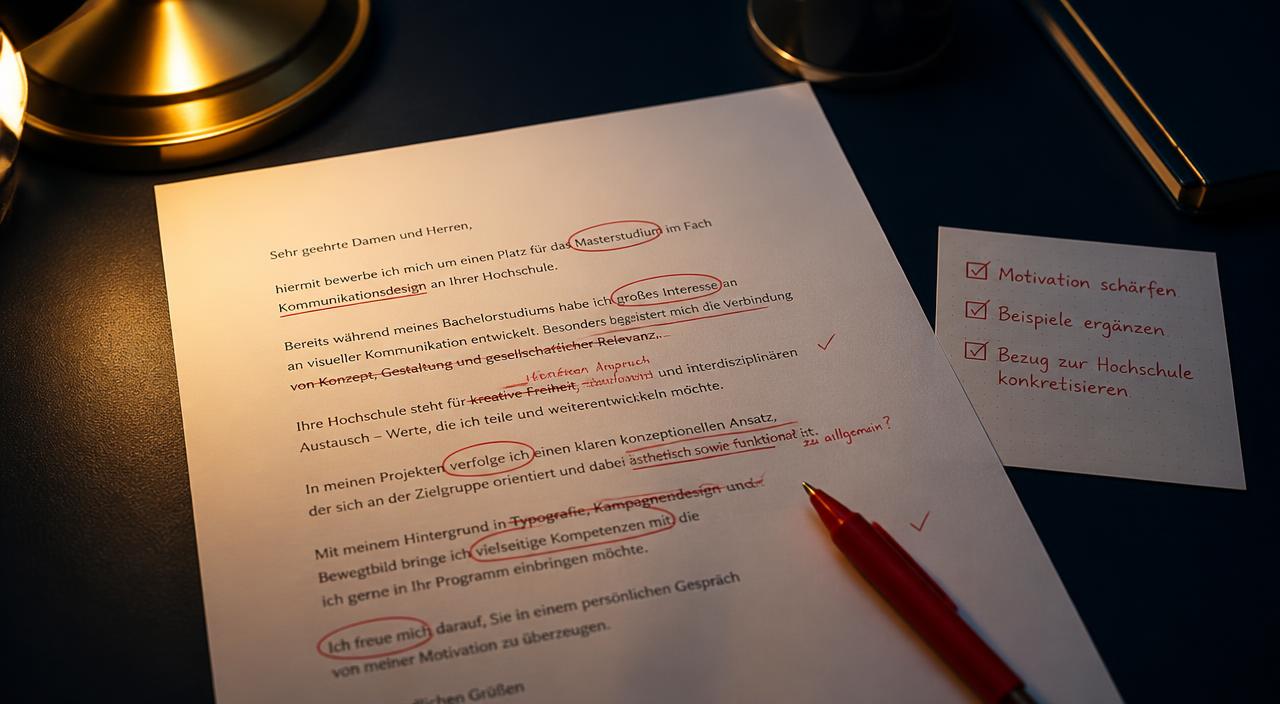
Most points lost in the Goethe-Zertifikat writing section don't come from bad German — they come from avoidable mistakes. Across several hundred sample exams we analysed at GoetheCoach, the biggest score-killers were skipping a required content point, forgetting the correct greeting or sign-off, and small spelling and punctuation slips. None of these require better grammar to fix — only attention. This guide walks through the six most common ones and how to stop making them.
→ Practise with instant AI feedback on GoetheCoach
How the Goethe writing exam is scored
Before the mistakes, the frame. Examiners grade your text on four things: whether you fully address the task (all the required content points, correct format and register), coherence (how well your sentences connect), structures (grammar and sentence variety), and vocabulary (range and accuracy). In our analysis, candidates were consistently strongest on addressing the task and weakest on coherence and vocabulary — worth knowing where the ceiling really is. But the fastest gains come from the mechanical mistakes below, because they cost points you've technically already earned.
Mistake 1: You skip a required content point (Leitpunkt)
Every Goethe writing task gives you two to four Leitpunkte — bullet points you must address. Miss one and you lose a large, fixed chunk of the "task fulfilment" score, no matter how good the rest of your German is.
This is the most common serious mistake in our data: nearly a third of sample exams (around 1 in 3) failed to cover at least one required content point. Usually it's not that the writer couldn't — they simply forgot, or ran out of words on the earlier points.
How to fix it: Before you write, number the Leitpunkte 1‑2‑3 on your scratch paper. Write at least one full sentence for each, and physically tick each one off as you cover it. Budget your words so the last point gets real attention, not a rushed half-sentence.
Mistake 2: Your greeting or sign-off is wrong or missing
A letter, email or forum post has a required opening (Anrede) and closing (Grußformel). These are free, guaranteed points — and a surprising number of candidates drop them. In our data, about 1 in 5 got the greeting wrong or left it out, and nearly 1 in 4 did the same with the closing.
How to fix it: Memorise two matched pairs and never improvise:
- Formal:
Sehr geehrte Frau … / Sehr geehrter Herr …→Mit freundlichen Grüßen - Informal:
Liebe … / Lieber …orHallo …→Liebe Grüße/Viele Grüße
Pick the pair that matches the task and write it down first, before the body. That way it can never be forgotten under time pressure.
→ GoetheCoach checks your greeting, closing and register automatically →
Mistake 3: Wrong register — mixing du and Sie
The task tells you whether you're writing to a friend (du) or an institution (Sie). Switching between them, or picking the wrong one, signals to the examiner that you don't control register — and it drags down your task score. Roughly 1 in 10 texts in our data used the wrong register or mixed it.
How to fix it: Decide du or Sie before your first sentence and stay consistent — including possessives (dein vs Ihr) and imperatives. When in doubt for a formal task, use Sie.
Mistake 4: Noun capitalisation and spelling
German capitalises every noun, and this trips people up constantly. Spelling and capitalisation together made up almost 3 in 10 of all the mistakes we counted — the single largest mechanical category. Writing das haus instead of das Haus is an easy, repeated point loss.
How to fix it: In your final read-through, hunt for one thing at a time. Pass one: is every noun capitalised? Pass two: obvious spelling. Isolating the check catches far more than reading for "everything at once."
Mistake 5: Punctuation, especially commas
German comma rules are stricter than English. A missing comma before dass, weil, wenn or a relative clause was behind around 1 in 8 mistakes in our analysis.
How to fix it: Learn one rule that covers most cases — put a comma before a subordinate clause (the ones where the verb goes to the end): Ich glaube, dass das gut ist. / Ich komme nicht, weil ich krank bin. That single habit removes most comma errors.
Mistake 6: Flat, repetitive writing
This is where the real skill ceiling sits. Coherence and vocabulary were the two lowest-scoring areas in our data — texts were understandable but repetitive, leaning on und, aber and weil and reusing the same handful of words.
How to fix it: Build a small toolbox and deploy it deliberately:
- Connectors: außerdem, deshalb, trotzdem, zuerst … dann … schließlich, einerseits … andererseits.
- Upgrades: swap gut for hilfreich / praktisch / sinnvoll; swap machen for a precise verb.
Two or three varied connectors and a few precise word choices visibly lift a text from "understandable" to "controlled."
Your 2-minute pre-submission checklist
Before you hand in — or hit submit — run this. These are the points people leave on the table:
- Every Leitpunkt covered? Count them against the task.
- Greeting present and correct for the register?
- Closing present and correct?
- One register only — du or Sie, all the way through?
- Every noun capitalised?
- Commas before dass / weil / wenn / relative clauses?
- Word count roughly on target — not far under?
Most of these cost you nothing but a moment's attention, and together they protect the biggest, most reliable block of marks on the paper.
→ Get your sample exam graded in seconds with GoetheCoach
Frequently asked questions
How is the Goethe-Zertifikat writing exam scored?
What is a Leitpunkt?
How many words should I write?
Do spelling mistakes really matter in the Goethe exam?
How can I practise Goethe writing before the exam?
This article is based on an analysis of several hundred sample writing exams submitted to GoetheCoach across CEFR levels A1–C2. Percentages describe how often each mistake appeared in that sample.
Get your writing graded in seconds
Write an exam-format task and get AI feedback on the four official Goethe criteria.
Start free